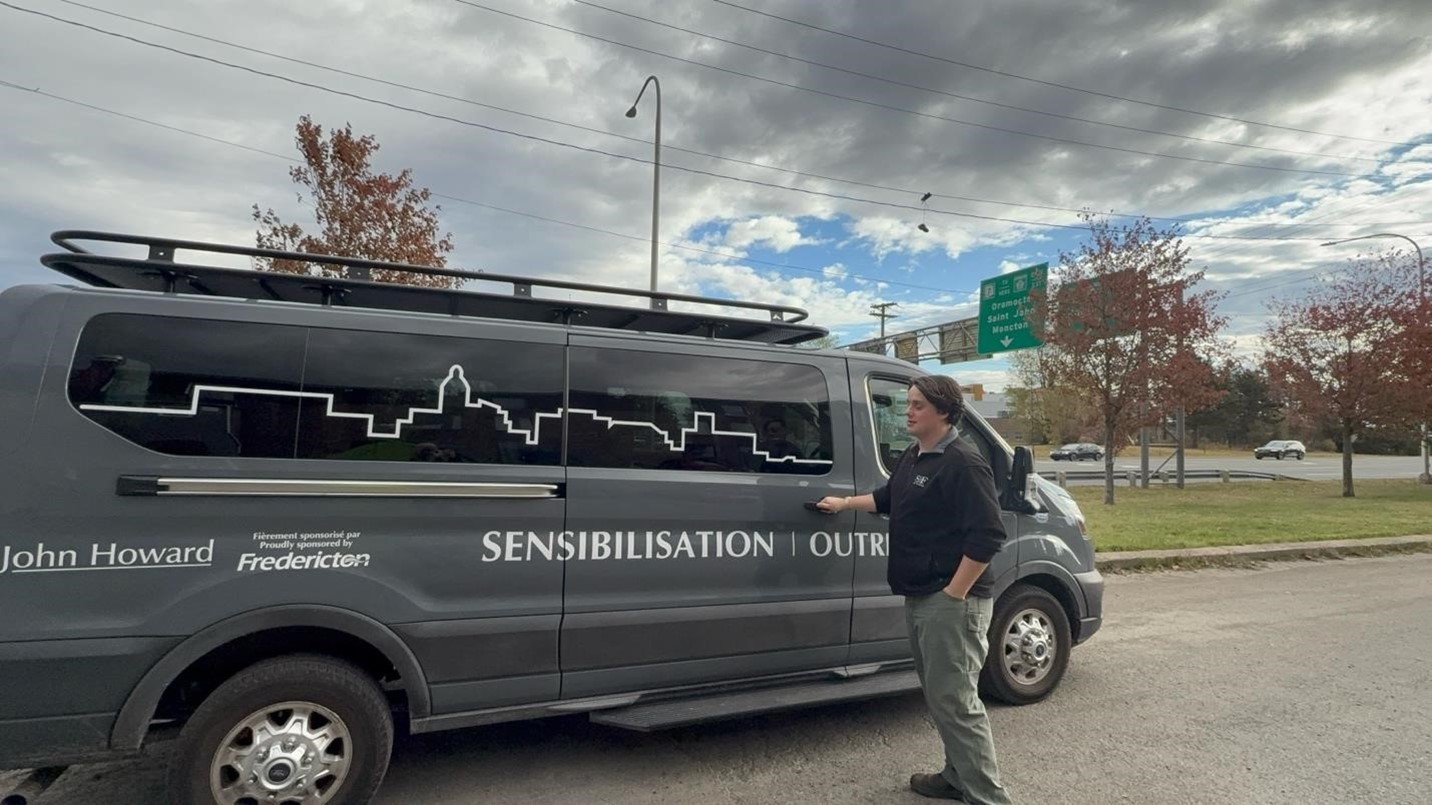
The engine hums against the cold as the grey outreach van pulls out of the Oak Centre’s lot in Fredericton, its back crates stacked with blankets, socks, naloxone kits, and cups of coffee that will cool quickly in the night air.
Frost spreads like a spiderweb across the windshield. It’s not yet 10 p.m., but across Fredericton, dozens of people are bracing for another night outdoors — in tents, beside dumpsters, under tarps weighed down by damp snow.
Outreach worker Max Goodine primarily works during the day but closely supports and coordinates with the overnight outreach team and understands how dangerous winter nights can be. He supports coordination with the overnight outreach team, assists with the follow-up, reporting and communication between shifts.
“You never know what it’s going to be,” he says. At night, the outreach team is often the only service on the street.
Goodine, 23, joined the John Howard Society expecting to work within the justice system.
Instead, he became a lifeline for those who are struggling with homelessness.
He estimates he knows “75 to 80 per cent” of the city’s unhoused residents by name. But the job, he says, is far from predictable.
“There are definitely days where things are heavier … and they’ll stay with me,” he said. “I like being able to help people … daily I get to see people getting help.”
According to Goodine, on a typical night, calls come from parking lots, shelters, police, or people who wave the van down. Members of his team pull up, check on whoever needs help, and try to figure out what comes next.
“They can actually pull up overnight, stop, talk to them, see what’s going on and how they get help,” he says.
Those moments are why the van exists. But they also reveal how precarious the city’s safety net has become.
A system at its breaking point
Average rents in New Brunswick increased by about 49 per cent between 2018 and 2024, according to the Canada Mortgage and Housing Corporation’s 2024 Rental Market Report.
A single adult receiving Transitional Social Assistance receives $794 per month, the Government of New Brunswick’s Social Assistance Schedule A shows.
“Life’s expensive,” Goodine says. “And let’s just say, magically, poof, I give you an apartment that’s 600 bucks a month. It’s a room, you’re going to live off $200 for the rest of the month. That’s hard, right?”
Because of that, people experience homelessness longer — or fall into it faster.
The outreach van fills the gap between the shelter system’s services and what people need to stay housed.
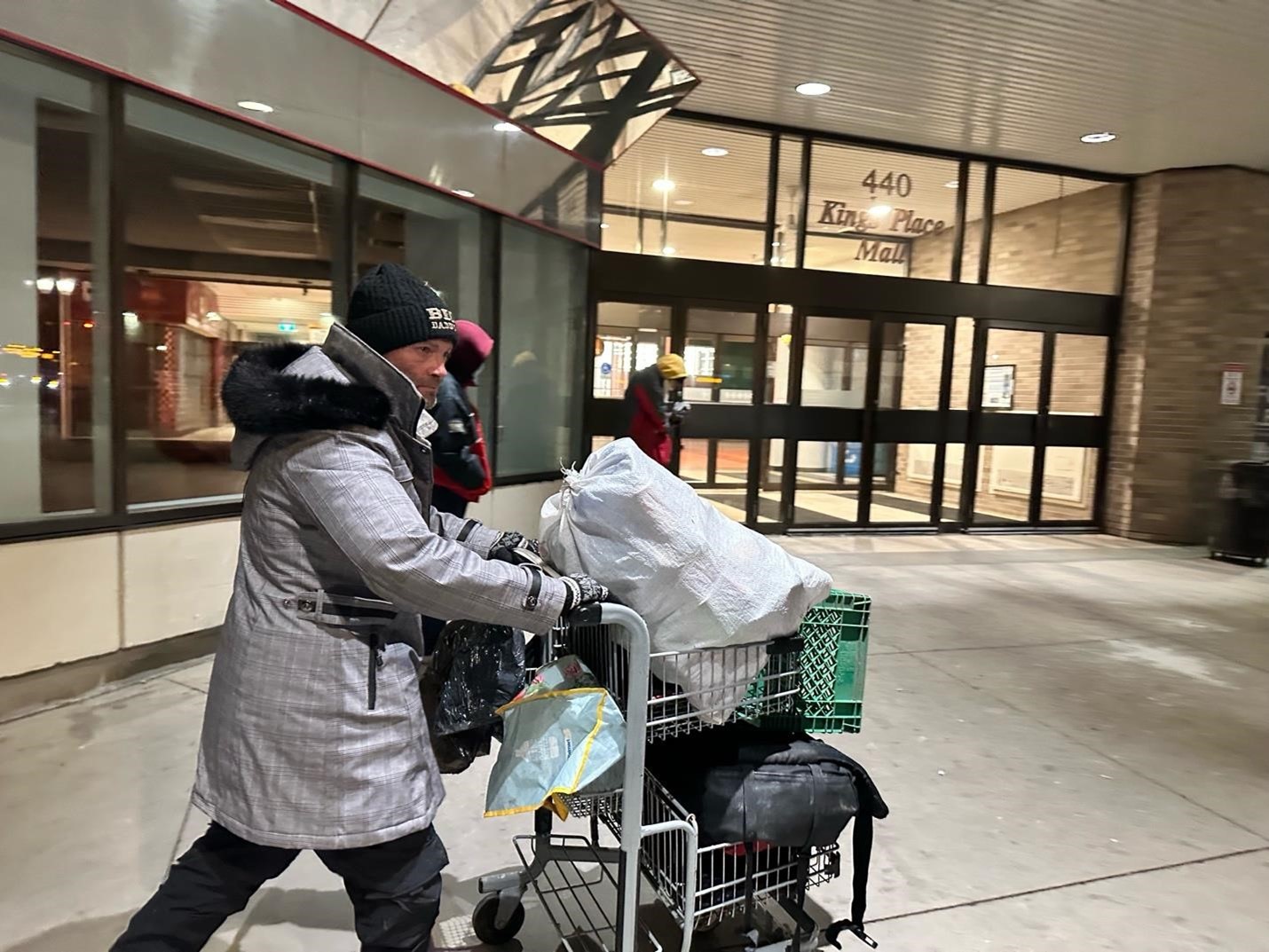
One person caught in that space is Bruce Hann, who has spent the last year and a half living on the streets or in shelters in Fredericton.
“This is where everybody hangs in,” he says, standing near the Kings Place building, a common gathering spot despite frequently being asked to leave by security guards or police officers. “But they don’t let you stay around too long. The security guards, they come out and they put the run to us.”
Hann became homeless after breaking his foot, an injury that cost him his roofing job and his stability. He has cycled through shelters and emergency beds, but his experience has been marked by frustration.
“They don’t help you,” he says. “They take your intake money and then kick you out on the street.” Hann uses the term “intake money” to describe the assistance cheque he received when he applied for support.
He says he was banned for six months from the Oak Centre for watching a movie on his phone past lights-out. “It’s just foolishness.”
Still, he says the outreach teams are the constant. “They come around with socks and hand warmers and stuff like that, food, snacks … Outreach is good.”
His message to policymakers is blunt: “Please help with the shelters in Fredericton,” he says. “People out here really need help. Get people housed.”
City Hall: pressure, compassion, and limits
Fredericton Mayor Kate Rogers says the crisis is one she grapples with daily.
“I’m very concerned for the people who are on the streets,” she said. “It’s unacceptable that people are unhoused and uncared for in a wealthy nation like Canada.”
But the city faces pressure from all directions — residents unhappy about living near encampments, citizens frightened by public drug use, and homeless people who have nowhere go.
Rogers says she’s “mindful of the concerns of residents and of businesses, for how that is also creating disruption in their lives.”
This is Fredericton’s first winter with the overnight outreach van fully operational.
“I cannot thank the John Howard enough,” Rogers says. “They put up their hand all the time to help out.”
But she knows the city is still far from a solution to the homelessness crisis.
“We need to get this addressed for everyone’s sake,” she says. “But it needs to be done properly.”
New Brunswick Housing Minister David Hickey said in an interview that the province’s approach has been to “stop the inflow into homelessness” by stabilizing tenancy and expanding rental supports.
He points to policies including the three per cent annual cap on rent increases, the direct-to-tenant rent benefit — which provides monthly assistance to low-income renters — and efforts to streamline housing decisions across provincial agencies.
But even he acknowledges that the scale of need is overwhelming. Winter intensifies that reality.
The night shift continues
Goodine says the outreach team driving around in the grey van encounters darkened parking lots, tents partially hidden behind mounds of plowed snow, people waiting for hot coffee, clean socks, or just a human conversation at 2 a.m.
When he’s working, he says, he goes with the mindset of “I help who I can help.”
On the coldest nights, he says the work becomes simple: you help the person in front of you and hope it buys them time.
“Realistically, there’s nothing you can do to fix everything in the world, right? There’s so much happening.”
The outreach van does not fix homelessness.
But it keeps people alive long enough to hope for something better.
And sometimes, on the coldest nights of a Fredericton winter, that is the difference between life and death.
Suzanne Shah is a third-year student at St. Thomas University and features editor at The Aquinian.
Correction: An earlier version of this article inaccurately described the role of outreach worker Max Goodine and implied direct observation of overnight outreach activities. Goodine is a daytime outreach worker who supports coordination with the overnight team. Descriptions of overnight work are based on his account. A reference to the colour of the van was also corrected.
This story was last updated on March 24, 2026 at 7:45 p.m.