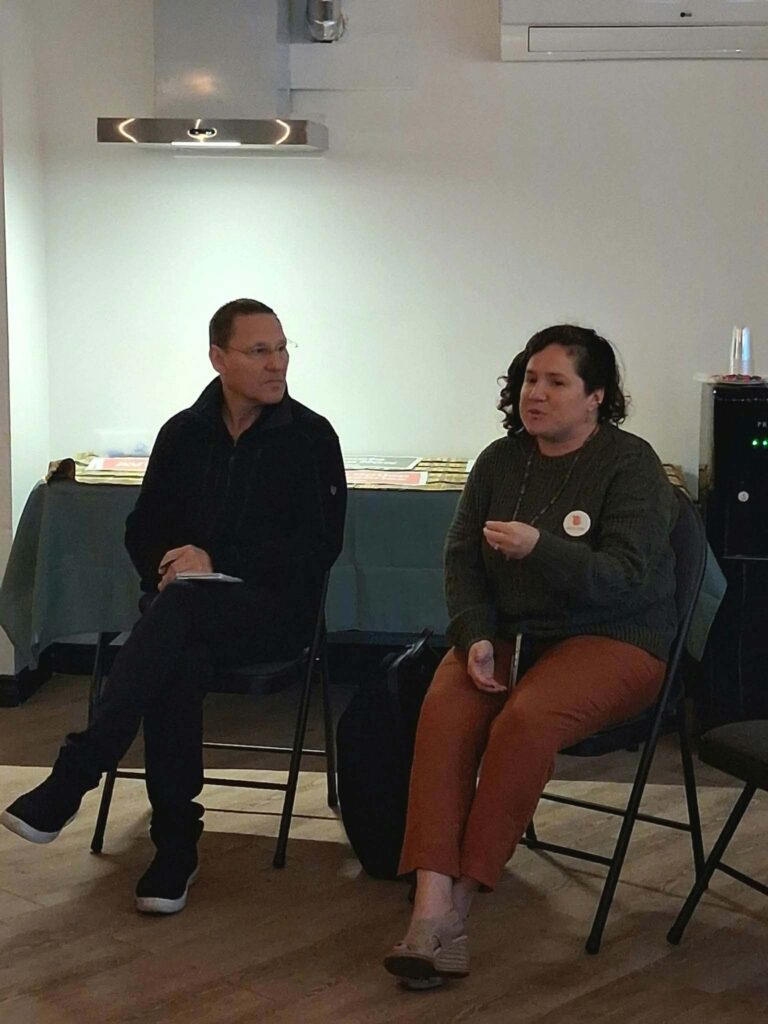
Avi Lewis, the leader of the federal NDP, spoke to a crowd of about 70 people in Saint John on Monday evening, as part of his For The Many, Not The Money Tour of Atlantic Canada. He also did a separate discussion with a number of community organizers and activists working to stop forest destruction, hyperscale data centres and mining. The democratic socialist leader took a few minutes to field some questions from the NB Media Co-op. This interview has been edited for length and style.
NB Media Co-op: There have been multiple reports of abusive conditions for migrant workers in the seafood processing industry here. And what is your position on this issue?
Avi Lewis: The real solution to the problem is status on arrival. Temporary Foreign Workers Program and a lot of the immigration programs are designed to create a workforce that has fewer rights and is more precarious and more exploitable. And if people get status on arrival, then there’s one standard for workers rights and we can all fight for it together. It takes away from the rising right-wing authoritarian movements in Canada, the ability to divide workers and pit us against each other. And it guarantees that we have a common fight for the fundamental rights of workers. And it’s the only solution to the problem. The migrant rights groups, the national organizations have been fighting for status on arrival for a very long time. We’ve come close a couple of times with different governments, including the Trudeau government, and they always yank it away at the last second. But status on arrival, it’s the only solution that would actually work.
NB Media Co-op: The Carney government is supporting projects including the controversial Sisson Mine here in New Brunswick. Activists are worried that it will destroy the Nashwaak watershed. What’s your take on this?
Avi Lewis: I think the major projects approach of the Carney government is extremely scary. And I think most Canadians don’t really understand how radical it is. It was already radical when they passed Bill C-5 more than a year ago. And now, we’re in a way revisiting the logic of structural adjustments, which was imposed on less industrialized countries in the 80s and 90s by institutions of the rich world, like the IMF and the World Bank. We’re seeing privatization, deregulation, and austerity, even special economic zones, which are in this legislation that is just one week old as we speak today. They’re creating regions of national interest with this latest legislation, Bill C-39, which are exactly the same as the special economic zones the IMF and the World Bank forced on countries like Vietnam, Indonesia, the Philippines and many other countries around the world, where there are government-free zones, regulation-free zones, where there are no labour rights, where there are no environmental assessments or protections.
Now, in Canada, we have the duty to consult Indigenous peoples enshrined in our Constitution in Section 35, and these regions of national interest will sweep aside the constitutional obligation to consult with Indigenous people. It should be free, prior, and informed consent, as in the UN Declaration on the Rights of Indigenous Peoples, but at least in our Constitution we have the duty to consult. That may be the way that we stop some of these projects, because you can’t violate the Constitution with the new law from the Government of Canada.
The movement against the mine here is going to be joined by many movements across the country against these mega projects, which could not proceed if all of the laws of Canada were enforced. This is why they are suspending many of the laws of Canada for these projects. To be clear, any minister in the government can now designate any project — and we don’t even know what the process is for designating these sacrifice zones, which will be virtually regulation free.
And so, I guess the only comfort for people who are fighting this mega project is to know that there are many communities organizing across the country fighting against this same agenda. The Carney government is still very popular, but we think that something the federal NDP can do is try to help people connect the dots and understand just what they’re up to in Ottawa and what kind of threat it poses to water, to land, to communities, to health, and to all of the systems that we rely on.
NB Media Co-op: What about the federal government’s support for artificial intelligence, which is contributing to the development of data centres including a controversial one nearby in Lorneville. Does AI need to be reined in?
Avi Lewis: It absolutely does, and we’re the only party that is calling for a pause or moratorium on data centres, until there are real laws and regulations in place. Look, there are regulations for everything from butter to bombs in Canada — except AI. There’s actually no regulations on this world-changing technology. And the government’s program is called “AI for All” that it should be called “All-In on AI.” They’re literally embracing the tech bro slogan: move fast, break things. We don’t want the government to move fast and break things. We want the government to slow down and f—king fix things.
And so we are calling for a pause on data centres and we’re calling for a humans-first AI policy. Right now the government is firing 40,000 public workers, slashing $60 billion of public spending, spending it on weapons, spending it on mega projects, spending it on tax cuts for corporations, while they tell those 40,000 public employees that they’re going to be replaced by AI. We believe that if you need a government service, you should only deal with other human beings. And that machines and robots should not be used to replace human beings.
We don’t believe that we can shut down and stop this technology. There are better ways to use it, with smaller data sets, smaller language models, consent given by people who give their data to the training, and much more targeted uses, and clean data under public control in truly sovereign data centres. We need public ownership over it to really have full data sovereignty.
NB Media Co-op: The current government and other NATO countries have agreed to U.S. President Donald Trump’s demand to invest five per cent of annual GDP to military spending. What’s your take on this policy direction?
Avi Lewis: Yeah, I don’t believe in setting arbitrary percentages of our economy — and it’s not just our budget, it’s our entire economy — and devoting them to reckless military spending. The Carney government has announced $80 billion of military spending in five years, even knowing that we’re under attack from the United States of America, and that 75 per cent of every dollar spent on weapons and war goes right to American weapons contractors.
They say they’re trying to change the countries that we do defence contracts with, but they’ve created an entire new government department just to spend all of this money, and they’re banking on weapons and war as economic development. If we’re gonna spend a percentage of our entire economy on anything, it should be combating the climate emergency. Because we’ve known for decades that it would be at least two per cent of global GDP needed to arrest the climate unravelling that we’re seeing right now, and to start making people safe from a very disastrous future that is now already unleashed on humanity.
So I’m not against all defence spending. Canada is a nation state, and as long as we’re a nation state, we do need to have an armed forces. But it was Trump that put pressure on all the NATO countries to up their military spending. We are under attack by Donald Trump. We are spending huge fountains of money on military contracts that are going back to the companies that Donald Trump is shoving down our throats. It makes no human sense.
What we need is to have a national debate about what are the actual threats to our country? What kind of defence do we need against them? And I would think more holistically about that than just military defence, because we do need more bombers: we need more water bombers, because we used to call it summer, and now it’s smoke season. And so the Canadian Armed Forces are already on alert for fire seasons, already helping out with flooding. I think there is a legitimate part of the military mission that could be used for climate defence. And I think that people would be excited and proud to serve in protecting our communities.
If we had an enemy that was burning down a town or two in Canada every year, we would have a military response. But we have the enemy of the climate emergency, which is burning down towns that people live in and love, and there’s no coherent national response. There’s not even a national fire-fighting force.
We need to slow down and actually put the enormous wealth of this country — hundreds of millions, billions of dollars of profits for banks, oil and gas, big grocery, corporate landlords, big tech companies, every single year — we need to go and get that money with a wealth tax and higher corporate taxes, and the government needs to redistribute that money in the form of universal public services for everyone, including those migrant workers who should have access to universal public services when they arrive.
Data Brainanta is an activist and volunteer reporter based in Saint John. David Gordon Koch is the NB Media Co-op’s staff reporter. This reporting has been made possible in part by the Government of Canada, via the Local Journalism Initiative.