
Volunteers from Save Lorneville recently held a public discussion at the Saint John Newcomers Centre, where activists called for sustained opposition to a controversial proposed AI data centre in the area.
The event, which took place on Oct. 17, featured Hamilton, Ont.-based activist and researcher Nick Tsergas, who built the website stopthedatacentre.ca as well as Mike Balkwill from the Small Change Fund, a charity that describes itself as specializing in crowdfunding for grassroots organizations. The public meeting was organized almost entirely by women from the community.
Tsergas said his investigation into the ill health effects of hyperscale AI data centres made him realize that there is no rule in Canada “to account for the implications attached to these facilities.” He called for a moratorium on the development of new data centres and expansions or retrofits of existing ones. That kind of moratorium would “give governments time to actually study the issue and see what they’re dealing with,” he said.
According to Tsergas, demand for hyperscale data centres comes primarily from seven major U.S. tech companies that are “in an arms race with each other to develop the biggest, smartest, most powerful, most tremendous AI model that you’ve ever seen, because they believe that if they can be the first one to reach that point, they will be the monopolist.”
READ MORE: Journalist links data centre push to gas plants and renewed interest in fracking
He pointed out that a whole array of speculative developer companies, such as the Calgary-based Beacon AI, are involved in the plans for the proposed data centre in Lorneville, on the outskirts of Saint John.
They build AI data centres to attract tech companies while expecting federal government subsidies under the Canadian Sovereign AI Compute Strategy, he said. He questioned the language of “sovereignty.”
“Building data centres in Canada does not automatically make them sovereign,” he said. “We need to define sovereignty and part of that is understanding who the users are of these data centres.”
He added that if developers are receiving public funds under the so-called Sovereign AI Compute Strategy, “there should be a rule that there are absolutely no U.S. companies allowed to use it.”
The next speaker, Mike Balkwill from the Small Change Fund, discussed strategies to stop speculative data centre development across the province. “You have to scare off investors,” he said.
One way is to show “visible, strong, consistent, persistent opposition,” because investors will go to the community where there is no opposition, Balkwill explained.
To slow down the race caused by the “monopoly game” among tech companies, Balkwill also suggested putting pressures on politicians.
“They’re not going to be talked to with facts into changing their mind. They’re going to be pressured, embarrassed and pushed into changing their mind,” he said.
That can happen in formal ways, such as petitions, and informal ways such as speaking to politicians “in the grocery store and the church, in the curling clubs and wherever you meet these people,” he said.
“There’s not enough profit to justify the investment of all that capital in those centres,” Balkwill said.
Judicial review pending
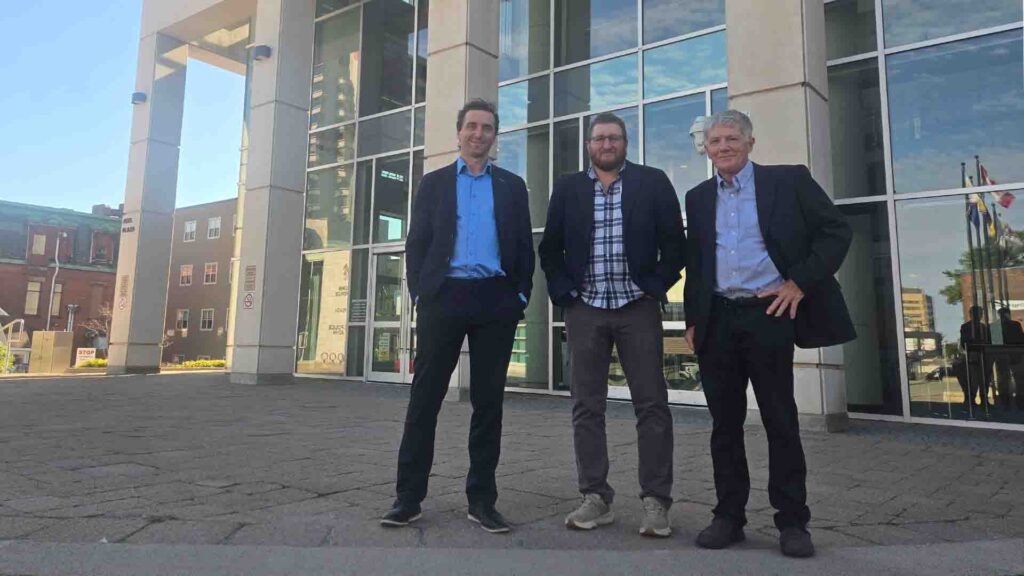
Meanwhile, the public awaits Judge Kathryn Gregory’s decision after a three-day judicial review hearing in early September over Saint John’s decision to expand the industrial park.
Lorneville residents Chris Watson, Adam Wilkins and Shayne Galbraith, who served as representatives for the community, put forth two grounds against the expansion.
They said the project lacked procedural fairness, alleging that the project’s approval was a foregone conclusion among some city councillors, and that it didn’t reasonably apply certain constraints from the City of Saint John’s own municipal plan and policies.
Lawyer Jonathan O’Kane, representing the city, argued that city council had responded to citizens’ opposition by engaging in an extensive public consultation process that showcased “consultative democracy in action.”
Towards the end of the hearing, legal counsel for the City of Saint John disputed the Lorneville applicants’ argument that city council was restrained from expanding the development due to certain municipal policies.
However, the city was in fact referencing language that was eventually deleted in a 2014 bylaw amendment, as the city’s lawyer acknowledged during the hearing.
A week after the hearing, New Brunswick Minister of Post-Secondary Education, Training, and Labour Jean-Claude D’Amours said that Lorneville’s proposed data centre would likely have to wait until a data centre policy framework is ready.
Meanwhile, Beacon AI and Texas-based power company VoltaGrid have organized an open house at the Lorneville Community Centre to present their proposed AI data centre and gas plant project. The event is taking place on Thursday, Nov. 5 at 5 p.m.
Data Brainanta is an activist and volunteer reporter based in Saint John.