A Mi’kmaq group in so-called Nova Scotia are fighting for their treaty rights.
At a recent environmental gathering in Tatamagouche, Alexina Doucette, a cousin of Donald Marshall Jr., addressed the people present to discuss their engagement.
Hunters Mountain is located west of Baddeck, on Unama’ki (Cape Breton Island).
Doucette was part of the first group of people that occupied the mountain. For 31 days, since Sept. 4, the group has been blocking the road to access Hunters Mountain. There is now a permanent encampment and sometimes up to 60 people at a time on site.
Doucette says there’s a lot of support, she “didn’t expect it to get this big (…) we thought ‘we’ll see where it goes.’”
Doucette is 47 years old, and she says she “grew up on the mountain, hunting and picking medicines.” Of the ancestral grounds, Doucette, said, “that mountain means so much to me but also to other people.”
When individuals visit this area, according to Doucette, “you don’t want to leave, and it calls you back.”
Another land defender, Judd Poulette, stated “connecting with ancestors” on the mountain has been his medicine. They have held sacred fire ceremonies on the mountain during the occupation.
One of the reasons for the land’s importance is that “our reservations are full (…) there’s only so much land reserved” for Indigenous use, according to Doucette.
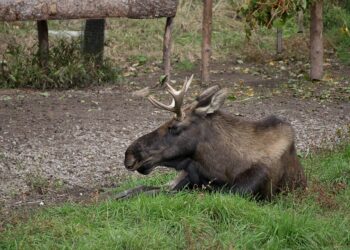
Doucette added that this area was “the only moose habitat we have left.” This is of central importance because, in the traditional “becoming a man” ceremony, young people hunt to provide food for other members of the community.

Logging companies have been clearcutting the land. Members of the Mi’kmaw nation have been finding medicines and petroglyphs on the land, as they explore it.
Recently, because of the various industries that have been exploiting Hunters Mountain, Doucette says: “we feel the brokenness.” However, in Indigenous customs, Doucette says, “we are supposed to leave the land better than we got it.”
For Doucette, “Since we took all the companies out of the mountain… it’s the first time in years the moose can hear each other… we’re going to have a successful rut.” A rut refers to the annual breeding season of male moose.
Elder Albert Marshall previously visited the land defenders on the mountain and told them “not to give up.” Doucette remarked it was an emotional visit: “it’s sad to see our Elders cry, they’ve been through so much already.”
The camp was raided and removed by the RCMP in its early days. There are logging companies like Port Hawkesbury Power, mining companies and the provincial electricity company, Nova Scotia Power, that use this land, but it is Crown land. Doucette pointed out that some of the logging companies have complied with the Mi’kmaw land defenders’ demands.
The Houston government in Nova Scotia recently reversed the bans on fracking and uranium mining. However, the Mi’kmaq are not being consulted and fear the downhill effects of these decisions on the lands. “They’re not putting us at the table for anything,” indicated Doucette.
The business and provincial authorities insist on speaking to the chief and council of the land defenders who, according to Doucette, have “no authority to speak to for” the group. In fact, she added: “we need support from elsewhere because we’re not getting it from the INAC leaders at all.”
Indigenous and Northern Affairs Canada (INAC) chiefs only have authority on Indian Act reserves. Doucette added, “They don’t want any of it, their deals are already national.”
Doucette got emotional when she told the Tatamagouche audience she’s had to have a difficult conversation with her 22-year-old daughter about taking care of her siblings if anything happened to her. Doucette specified: “they’re going to come after us hard.”
The reason for the group’s worry is a bill attacking Indigenous sovereignty that recently went through the provincial legislature.
Bill 127, “Protecting Nova Scotians,” is an omnibus bill that includes positive changes to tenant rights and around identity issues.
Some things seemed like “good things” that people could rally around, according to Woman of the Green Earth Michelle Paul, a member of the Wasoqopa’q First Nation, who addressed the Nova Scotia Legislature in opposition to the bill.
View this post on Instagram
However, one of the precisions pertaining to Crown Land in Bill 127 states that any “blocking obstacles, structures” on roads will be subjected to a fine of $60,000 or six months in jail. The land defenders worry they will be considered obstacles.
Paul commented on “the audacity of the government” to pass the bill at the time that they did, in and around Truth and Reconciliation Day and Treaty Days when Indigenous people were busy. This bill was presented and passed in eight days, introduced on Sept. 23 and passed third reading on Oct. 3.
Because the land defenders at Hunters Mountain are protesting on Crown Land, it is not possible to get an injunction to prevent them from being up there. Currently, “there’s nothing impeding access to the road,” according to Paul.
Another land defender present, Darlene Gilbert, has been chalking messages on the sidewalk in front of Province House. Gilbert stated that Bill 127 was “only aimed at us because we decided to save our mountain.” She added: “we are not willing to give up who we are… We come together and we collaborate… We are all Treaty people.”
Cheryl Maloney is another Mi’kmaw community member who is contributing to the work by carrying out a Medicine trail search for cancer fighting plants and medicines in Crown lands in Mi’kmaki.
Maloney stated: “There’s not a heck of a lot left,” and added, “we’re losing land by the minute.”
The Alton Gas decision from 2020 was “a big win,” according to Maloney. The judge sided with Indigenous people in the need for consultation and the decision has strong language built into it.
Maloney said her group tested the previously existing language by going over to “Treaty Island” —a piece of land that emerged from Alton’s work in the Stewiacke river— to build a tipi, picking medicines, fish, and put up a flag.
Maloney stated: “No cops came. They’re protected areas once you’re on the Crown land doing what we’re culturally allowed to do.”
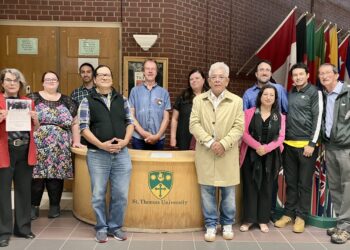
Participants present also read a letter addressed to Mary Simon about the situation, asking for her help. The group of land defenders is similarly looking for funding and support from others. To directly support the Mi’kmaq Elders and land defenders’ efforts at Hunter’s Mountain, you can send an e-transfer to alexina2468@gmail.com.
Doucette is resolved to fight for Hunters Mountain, saying, “My passion called me back to that mountain.” Paul reminded those present that they are all Treaty partners with obligations. “The ball is in your corner,” she said.
Sophie M. Lavoie is a member of the NB Media Co-op’s editorial board.


![‘We’re still here, and we will always be here’: Mi’kmaq language program fosters pride [video]](https://nbmediacoop.org/wp-content/uploads/2026/09/MikmaqCampAug142026-120x86.jpg)