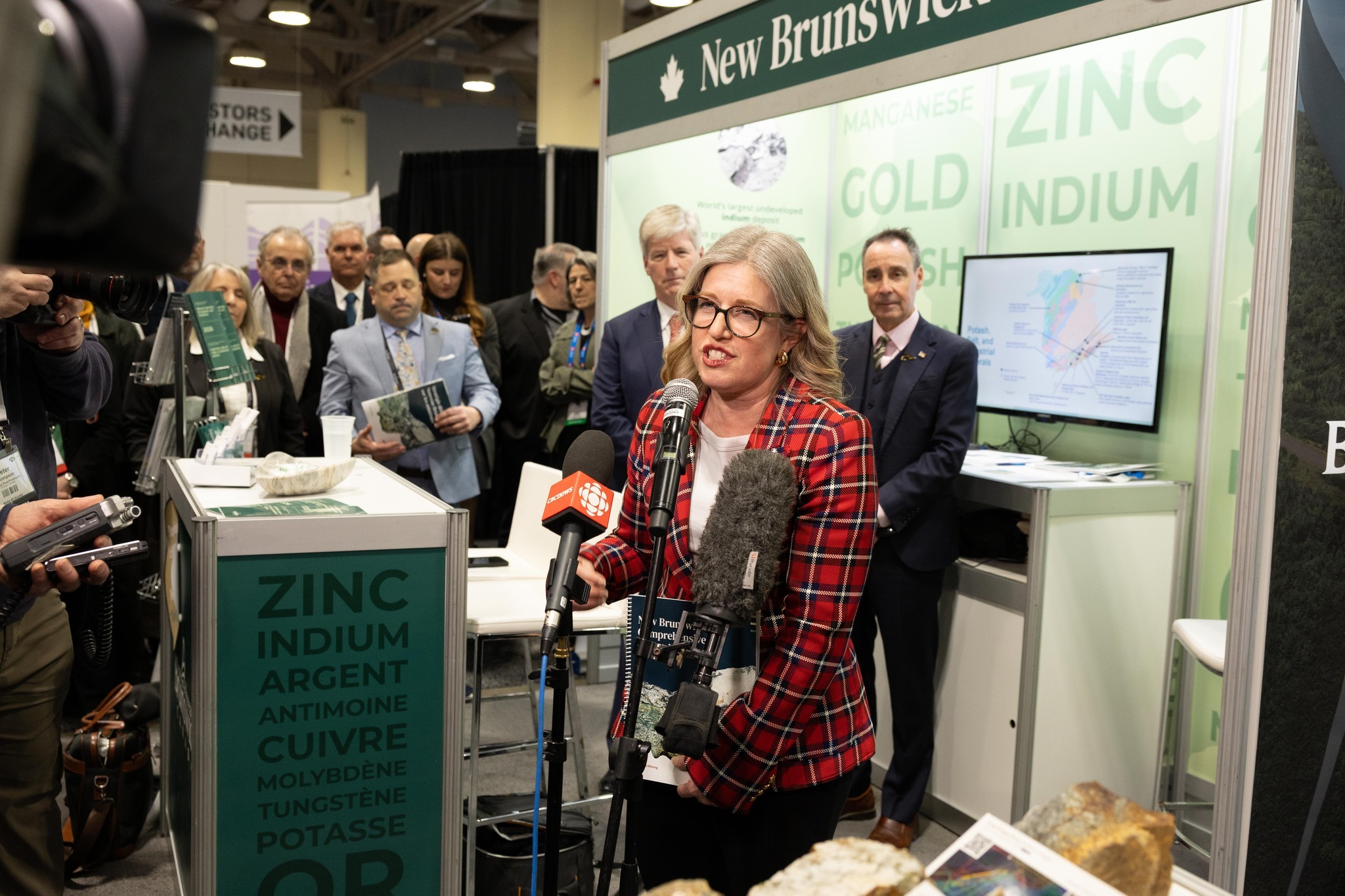

Enabled by Prime Minister Carney’s response to Donald Trump’s blatant assault on the Canadian economy, the Holt government has now released a ‘comprehensive minerals strategy’ designed to revisit the glory days of the mining industry in this province. The strategy, released at an international mining conference in Toronto, is written for, and indirectly by, the mining industry. The goal is to attract investment in mineral exploration and development by domestic and international companies. It does this in two ways: first, promoting the known and potential mineral deposits; and second, promising to expedite and ‘de-risk’ investment through streamlined regulatory processes and new ‘fiscal tools’ – in other words, various public subsidies to offset costs.
Over the past decades, it has become routine for governments to invoke sustainable development and environmental stewardship as principles underpinning economic growth strategies. Typically, however, the words are simply platitudes within a business-as-usual framework. Such is the case with the minerals strategy. Those terms appear many times throughout the document, yet they are little more than greenwashing a notoriously un-green industry.
Let’s look at each one in turn. The meaning of sustainable development is highly contested, often interpreted as supporting whatever economic development scheme is on the table. But the words themselves are not complicated. In very simple terms, if development is sustainable, it is capable of being sustained over a long period of time, and it doesn’t degrade the environment within which it is located.
In no world can mining be sustained over the long term. Minerals are non-renewable and so they run out. Mines close when they are no longer commercially viable, throwing workers on the unemployment line and gut-punching communities depending on those industries. We have lots of examples of this in New Brunswick. The proposed Sisson mine, for instance, has a projected lifespan of 27 years.

Hypothetically, the minerals sector could be sustained over some longer period as long as new mines continue to open as existing ones close. But the second dimension of sustainability – that development does not degrade the environment within which it takes place – cannot be even hypothetically argued.
READ MORE: Conservationists sidelined in lead-up to New Brunswick strategy for ‘sustainable mining’
READ MORE: No mention of UN Declaration on the Rights of Indigenous Peoples in new minerals strategy framework
Mining is by definition environmentally destructive. Ecosystems are destroyed as mines are established; toxic wastes are generated; water and air are polluted; wildlife is displaced. These are the inevitable products of mining; there is no mine anywhere that has avoided these consequences, even using ‘modern best practices.’ Some mines are worse than others. The best that can be said about environmental stewardship in mining is that the company genuinely tries to minimize the harm from these inevitabilities, as well as the risk of a catastrophic failure that would permanently destroy downstream freshwater systems.
What the New Brunswick mining strategy seems to mean by environmental stewardship is that companies will be responsible for land reclamation after mine closure. Yet New Brunswick governments have not had much luck holding mining companies accountable after the mine has closed. No closed mine site has been reclaimed, and at three former mines, the Department of Natural Resources has had to take over treatment of contaminated wastewater, a perpetual responsibility (is this cost being subtracted from the royalties paid by the companies while they were in business?).
The new mineral strategy suggests this won’t happen again. A big part of the problem, however, is that transnational mining companies are notorious for staying beyond the reach of provincial governments. Ownership is a shell game of consolidations and buy-outs; the local subsidiary goes bankrupt as deposits are depleted or price collapses; parent corporations with the best legal trickery money can buy are protected from subsidiary’s liabilities. It’s an extract-and-run business model that leaves local environments devastated and communities high and dry.
The only way the Holt government could ensure long term accountability over the closure and reclamation of a mine site including the perpetual financial responsibility for toxic waste water treatment would be to extract a huge bond from the company up front. Yet, the Holt government’s strategy is to make it easy for companies to set up shop by streamlining regulations and permitting, and using ‘fiscal tools’ to ‘derisk’ investment. Are they really going to make sure mining companies continue to pay their way long after a mine is closed? Seems like that might be a deterrent to an industry that isn’t used to maintaining perpetual stewardship of their toxic sites.
So let’s be honest about this minerals strategy. It is not sustainable development nor environmental stewardship. This is just window dressing – lipstick on a pig, one might say.
The environmental impact assessment (EIA) process to which new mines will be subject is not about preventing environmental damage, let alone stewarding the environment. It is about deciding what level of environmental degradation is likely to be acceptable, putting conditions on a development only to the extent that a company is prepared to accept financially.
Case in point: the New Brunswick EIA panel has already approved the Sisson Mine with a toxic liquid tailings impoundment 10-times the size of that of the Mount Polley mine in British Columbia. That tailings impoundment – built to Canadian standards – failed, poisoning the water downstream for hundreds of miles. After 12 years, it still isn’t cleaned up. The Sisson EIA panel could have ordered Northcliff Resources to use dry stacked waste storage to prevent the pollution of the Nashwaak and Wolastoq watersheds, but they didn’t. Too expensive.
Really? What price tag has the government put on those rivers and the people who live along them? What risk is the Holt government willing to impose on these gifts of nature for which we are responsible? What is it worth to entice a foreign company to extract minerals to sell to, for one, the US Department of War, while creating a few hundred jobs for a couple of decades?

- READ MORE: ‘Continuum of genocide’: Pentagon funding of Sisson mine provokes renewed opposition from Wolastoq Elders
- READ MORE: NB Update: Mining strategy a ‘sales pitch’ to industry | New edition of Passamaquoddy-Wolastoqey dictionary
I am not saying mining shouldn’t happen in New Brunswick. What I am saying is that the government must not sugarcoat the environmental impacts this will have. While mines cannot be sustained over the long term, environmental damage will long outlive those mines.
If the government is going to get social licence for this strategy, and if they are truly concerned about environmental impacts, they need to do two things.
First, they need to stipulate that only dry stack waste storage technologies can be used at mine sites. They also need to stipulate that cyanide-leaching processes cannot be used. Both liquid tailings and cyanide leaching have made huge messes and should not be allowed. If that means abandoning certain types of mines, then so be it. Disasters are well-known and can and should be prevented.
Second, the mining strategy next steps must be subject to wide scrutiny by the general public. The government promises transparency in their processes. So far this only applies to industry. Indeed, the government intends to provide ‘concierge service’ to the industry; meanwhile, the coalition of communities, landowners and Indigenous groups opposing the Sisson mine were not granted an audience by Minister Herron as the strategy was being developed. The EIA process, always the default that government uses to channel and neutralize concerned citizens, is a sham as far as public participation goes.
Citizens have a right to know what’s being planned and a right to weigh in on the risks and conditions they are willing to accept as mining companies come calling. It isn’t acceptable that these trade-offs continue to be negotiated behind closed doors with the industry, while concerned citizens are left out in the cold.
Janice Harvey, PhD is the Director of Sustainability and Environmental Studies at St. Thomas University in Fredericton.
![Is a Moncton company helping to build jet fighters bombing Gaza? [video]](https://nbmediacoop.org/wp-content/uploads/2024/06/ApexMay192024-350x250.jpg)
![Amid push for ‘nation-building projects,’ critics warn of ecological devastation [video]](https://nbmediacoop.org/wp-content/uploads/2026/10/MineBabyMineSept242026-2-350x250.jpg)

![Is a Moncton company helping to build jet fighters bombing Gaza? [video]](https://nbmediacoop.org/wp-content/uploads/2024/06/ApexMay192024-120x86.jpg)
![Massive increase in military spending imposed by U.S. with little media pushback [video]](https://nbmediacoop.org/wp-content/uploads/2026/10/AlexCoshSept232026-120x86.jpg)