The provincial government’s newly released mining industry strategy contains multiple references to “environmental stewardship,” but the Conservation Council of New Brunswick says that environmental and community groups were sidelined by Minister of Natural Resources John Herron during consultations.
“We’re extremely disappointed that Minister Herron and his department did not meet with the Conservation Council and other organizations to discuss the mining strategy, despite our request to do so weeks ahead of its release,” said Beverly Gringas, executive director of the Conservation Council of New Brunswick, in an email to the NB Media Co-op.
“Decisions about mining will shape the future of our water, forests, people’s health and our communities. These are long-term choices with real consequences for all New Brunswickers,” she said.
“Moving ahead without meaningful engagement undermines public trust and misses the opportunity to draw on the knowledge, experience and perspectives of people who work on local issues and understand the impacts these decisions will have on our communities.”
The 39-page minerals strategy document was launched Monday afternoon at a mining industry conference in Toronto. The NB Media Co-op requested an interview with Herron but he wasn’t available, and there was no livestream or broadcast from the event.
Premier Susan Holt and federal Energy and Natural Resources Minister Tim Hodgson also participated in the announcement, which took place during the annual convention of the Prospectors and Developers Association of Canada.
“New Brunswick has what the world needs, and we have a responsibility to develop those resources the right way — with strong environmental standards, meaningful partnerships with Indigenous communities, and good-paying jobs for New Brunswickers,” Holt said in a media release.
The provincial Liberal government plans to introduce amendments to the Mining Act later this year to “ensure the regulatory regime is the most agile, predictable and timely in Canada.”
The PDAC convention brings together “more than 27,000 attendees from over 125 countries,” according to organizers.
The event also attracted mining justice activists who held a rally on Sunday drawing attention to the Canadian mining industry’s role in the military industrial complex, environmental harm, and human rights abuses in conflict zones.
Province commits to ‘meaningful Indigenous participation’
The document emphasizes “meaningful Indigenous participation,” listing several government commitments. It states that the province will
- “publish formal guidelines for engagement, consultation and collaboration” with First Nations for mining industry proponents;
- “enable opportunities for leadership dialogue” between First Nations leadership and the Department of Natural Resources;
- “ensure proponents receive First Nations cultural awareness training”;
- “create career pathways and training opportunities for Indigenous youth and early‑career professionals”;
- “promote opportunities for Indigenous suppliers.”
The new strategy acknowledges the constitutional duty to consult with and accommodate First Nations and to uphold Aboriginal and treaty rights, but it doesn’t mention the UN Declaration on the Rights of Indigenous Peoples.
Groups representing Wolastoqey and Mi’kmaq chiefs in New Brunswick didn’t immediately respond to requests for comment.
New Brunswick’s Liberal government has touted the mining sector as an engine of economic development, arguing that the province is rich in several of the “critical minerals” that the federal government has listed as essential for products such as mobile phones, solar panels, and military hardware.
The federal and provincial government have both taken steps to accelerate natural resources projects amid U.S. President Donald Trump’s trade war.
In particular, Ottawa and Fredericton have promoted the controversial Sisson project. The proposed open-pit tungsten and molybdenum mine would be located about 60 kilometres northwest of Fredericton in the Upper Nashwaak River, a tributary of the Wolastoqey River.
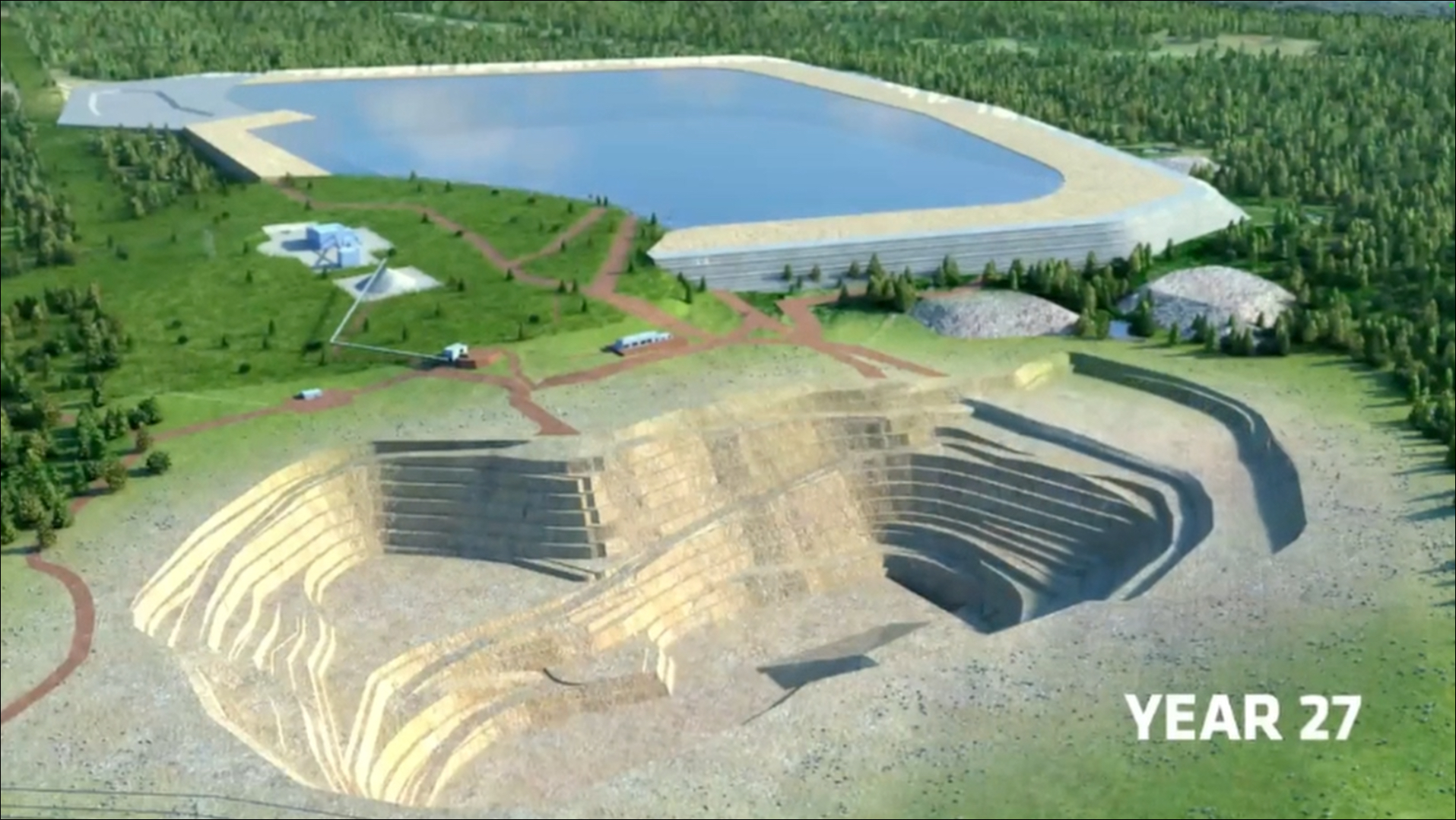
While the minerals strategy stresses that numerous other deposits exist across New Brunswick — such as zinc, copper, gold, silver, antimony, potash, manganese and indium — the Sisson project is mentioned several times.
In November, Prime Minister Mark Carney referred the Sisson project to the Major Projects Office, a body mandated to speed up “nation-building projects.”
In December, New Brunswick signed a deal with the federal government meant to speed up the development of major projects.
Critics have said that approach threatens to water down environmental assessments while sidelining First Nations.
David Gordon Koch is a journalist with the NB Media Co-op. This reporting has been made possible in part by the Government of Canada via the Local Journalism Initiative.

![Is a Moncton company helping to build jet fighters bombing Gaza? [video]](https://nbmediacoop.org/wp-content/uploads/2024/06/ApexMay192024-350x250.jpg)
![Massive increase in military spending imposed by U.S. with little media pushback [video]](https://nbmediacoop.org/wp-content/uploads/2026/10/AlexCoshSept232026-350x250.jpg)
![Amid push for ‘nation-building projects,’ critics warn of ecological devastation [video]](https://nbmediacoop.org/wp-content/uploads/2026/10/MineBabyMineSept242026-2-350x250.jpg)
![Is a Moncton company helping to build jet fighters bombing Gaza? [video]](https://nbmediacoop.org/wp-content/uploads/2024/06/ApexMay192024-120x86.jpg)