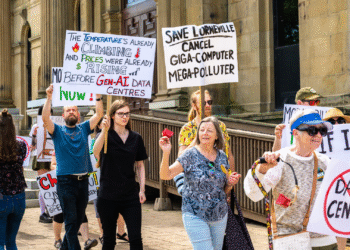
Editors’ note: The Telegraph-Journal refused to publish this op-ed, written by a local resident to explain why over 700 people gathered on the shores of the Bay of Fundy this past Saturday, May 30, to oppose Energy East, TransCanada’s proposed 1.1 million barrel per day pipeline. Like nearly all print media in the province of New Brunswick, the Telegraph-Journal is owned by the Irving family, whose company, Irving Oil, has partnered with TransCanada to build a maritime export terminal for the proposed Energy East pipeline.
I am a proud resident of Red Head, Saint John, a small rural community with quiet roads and beautiful coastal views.
TransCanada is proposing a 1.1 million barrel per day pipeline from Alberta to Saint John. After travelling almost the entire length of the country, it would end at a new deep water port on the Bay of Fundy. The Energy East project also includes a massive tank “farm” to store the oil that would be loaded onto waiting ships — across the street from my home.
- Confronting Irving Oil and TransCanada at the end of the line in New Brunswick
- VIDEO: New Brunswick residents talk about their concerns with Energy East
- Ten questions for NDP energy critic Guy Caron about Energy East
Why do I oppose Energy East?
I’m worried about the air we breathe.
Saint John is highly industrialized, and residents are already exposed to increased health risks from air pollution, not to mention the oil smells near Irving’s new rail facility. We have, among other industries, Irving Oil’s export terminal and the Canaport LNG terminal. We have 38 times the industrial pollution of Fredericton and 243 times that of Moncton. A recent study found lung cancer rates 30 per cent higher in Saint John than in either of these communities. The health experts I’ve spoken to say that existing regulations for air pollution as inadequate. Yet TransCanada says air pollution from Energy East would not be significant.
I’m worried about the prospect of a spill or fire at the tank storage farm.
The deputy fire chief in Burnaby, B.C., has issued a scathing report on the risks presented by a similar oil tank storage facility on the West Coast. The chief warned that a fire at the expanded tank farm could create a “nightmare scenario” resulting in a massive urban evacuation.
I am having trouble trusting TransCanada and Irving Oil. Despite several requests, TransCanada has refused to hold a public meeting with Red Head residents with an open question-and-answer period.
A recent Reuters investigation of the New Brunswick Department of Energy found that since 2012, Irving’s export terminal has experienced at least 19 accidents classified as “environmental emergencies.” In 2013, Irving received a formal warning for taking more than a day to report a storage tank leak at the Canaport facility.
According to National Energy Board statistics, TransCanada has had more pipeline ruptures than any other company in Canada. The company’s electronic monitoring equipment won’t even detect a spill that is less than 1.5 per cent of the pipeline’s capacity. This means over 2 million litres can spill before anyone is alerted.
My concerns don’t stop at the end of my driveway.
The Energy East project would see 115 oil tankers in the Bay of Fundy — and potentially far more now that the Cacouna, Quebec, port has been cancelled. The endangered North Atlantic right whales in the Bay of Fundy are already vulnerable to ship strikes and low-frequency ship noise, both of which Energy East threatens to worsen. Moving in and out of port for export, Energy East tankers would carry 1 to 2 million barrels of oil each.
Energy East would ship diluted bitumen from the tar sands. Sticky and heavy, bitumen from Alberta’s tar sands separated from the diluents (chemicals) and sunk in Michigan’s Kalamazoo River during a pipeline spill in 2010. This cost Enbridge more than $1 billion to clean up, yet submerged oil remains on the river bed to this day.
One federal study found diluted bitumen sunk and formed “tar balls” in marine conditions similar to the Bay of Fundy. A major spill that occurs during loading of the tankers or when the tankers are leaving wouldn’t just threaten whales. It could be a serious blow for all ocean-dependent economies and jobs.
A draft federal report accessed through freedom of information admits that not enough is known about the potential toxic effects of tar sands crude in our waterways. Energy East passes through or comes near more than 300 waterways, including at least six of the St. John River’s main tributaries.
I want to do my part in helping protect future generations.
The Energy East pipeline would create more climate pollution than any single Atlantic province.
A recent scientific report says 85 per cent of Canada’s tar sands need to stay in the ground if we are to avoid the worst of climate change. Industry wants to double production by 2030 and will pursue both pipeline and rail expansion to export their product. Filling the Energy East pipeline would allow a close to 40 per cent increase in tar sands production.
We can do better. This export pipeline puts so much at risk for such short-term benefit. There is much more at stake than profit.
Lynaya Astephen is a resident of Red Head and the spokesperson for the Red Head – Anthony’s Cove Preservation Association. This article was originally published in Ricochet.




![Is a Moncton company helping to build jet fighters bombing Gaza? [video]](https://nbmediacoop.org/wp-content/uploads/2024/06/ApexMay192024-120x86.jpg)