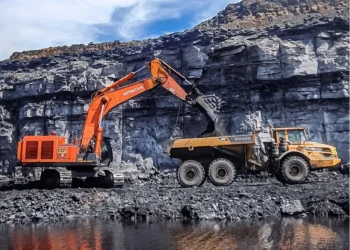
Canada and its provinces, collectively and individually, are desperately seeking ways to counter and protect against the unpredictability of U.S. trade relations. Given this uncertain situation, it is interesting to ask, who benefits from the U.S. Department of Defense injecting millions into the Sisson Mine project in New Brunswick?
The Sisson Mine is a proposed open-pit tungsten/molybdenum mine located in the pristine Nashwaak Watershed of Central New Brunswick.
The recent investment of $15 million USD by the U.S. Department of Defense into the Sisson project under the U.S. Defense Production Act Title III certainly has profound implications for Canadian security. The “vision” of the defense department office mandated to implement the Act is defined to be:
“To protect and maintain the resiliency and long term sustainability of domestic supply chains and to enhance national security and preserve the supremacy of the American Warfighter [author’s emphasis].”

If the current uncertainties in the U.S.-Ukraine Critical Minerals Deal 2.0 are any indication, some hidden “Quid pro Quo” undoubtedly exists in the fine print of the Sisson investment deal between the U.S. Department of Defense and Northcliff/Todd, the proponents of the Sisson Mine project.
Rather than enhancing Canada’s self-sufficiency, this deal seems destined to undermine any attempts by the Canadian nation to secure itself against U.S. economic (and potentially military) aggression.
Meanwhile, the Sisson project CEO, has reportedly extended the timeline for Sisson startup to another five years into the future.
Given that one of the conditions of Environmental Impact Assessment (EIA) approval was that the mine initiate startup within six months of Dec. 2015, this is a strange projection on Sisson’s part.
Noting that Northcliff/Todd’s current extension expires in Dec. 2025, this appears to be a stalling tactic to either gain another five-year extension, or a stall to outlive Holt Liberal antipathy and/or Trump injected investment uncertainty.
The project’s antiquated 2013 economic feasibility study and its 2015 EIA have both lost relevance with respect to rapidly escalating capital and operating costs, and with respect to updated tailings storage technology. The graph below shows how the abnormally inflated tungsten price of 2011 has not kept pace with the rise in capital costs and operating costs as reflected in the consumer price index over the last 12 years.

It is small wonder the Sisson project management is hedging on the project’s viability.
A 2024 study observed that 13 of 27 mining projects with approved environmental assessments in British Columbia over the last 30 years have never reached fruition, primarily because economic realities were ignored in the assessments.
For the last ten years, the Sisson management has avoided updating reclamation costs and post closure water treatment costs as required under its EIA Conditions of Approval. It is not surprising that they would be fearful of the outcome of an updated economic feasibility study.
It is also important to consider the implications of the Sisson Mine with respect to New Brunswick’s energy security.
The contention by the mine’s proponents in their 2015 EIA that NB Power would sell power to the mine at or near the cost of production is cause for alarm. The average New Brunswick homeowner is already finding it difficult to keep up with rapidly inflating power bills. Subsidization of this unprofitable mine with power at or near the cost of production would leave the average homeowner facing even greater power bills with no net benefit.
The mine is projected to use 310,433,482 kwh (0.310Twh) of power per year, and is projected to pay the current industrial rate of $0.075 per kwh compared to the current residential rate of $0.157 per kwh. This implies a $0.082 per kwh subsidy, translating into $25,455,545 per year. All this for an unprofitable mine destined to weigh down the province economically and environmentally for decades, if not centuries.
The additional 0.310 Twh is also an additional 1.8% load on an already overloaded electrical power system. NB Power is currently challenged, financially and logistically, by an unprofitable and ageing Point Lepreau Nuclear Power Plant, a Mactaquac power plant and dam in need of refurbishment, and the projected end to the burning of coal at the Belledune power plant.
A 42km, 138kV power line dedicated to the mine is also a matter of concern because its construction cost is to be borne by the province. Originally estimated at $14 million in 2013, materials and labour have escalated significantly in the last 12 years. Data from one source translates into an approximate cost of $1.7 M CAD per km for a similar 138kV line in the U.S., implying a current cost of $71M CAD for the 42km Sisson extension.
The U.S. Department of Defense investment in the Sisson mine is ostensibly to finance an update of the project’s 2013 economic feasibility study. The province would be wise to demand an independent study. Relying on the proponents’ selected consultant would be like accepting the opinion and conclusions of the opposing lawyer in a legal case. The province should have realized long ago that lack of independent review of proponents’ feasibility studies in the EIA process is a recipe for failure and economic hardship.
It is also time to see the U.S. Department of Defense “investment” in the Sisson mine project as a feature of U.S. imperialism. It is ironic that the U.S. empire, so paranoid about Chinese involvement with infrastructure projects in the Americas, asserts U.S. “Manifest Destiny” whenever it pleases in mining and infrastructure projects in Canada and the rest of the Americas, not to mention on the doorstep to Russia.
Lawrence Wuest is an ecologist living in the Upper Nashwaak on unceded territory of the Wəlastəkwiyik, Mi’kmaq, and Peskotomuhkati.
![Amid push for ‘nation-building projects,’ critics warn of ecological devastation [video]](https://nbmediacoop.org/wp-content/uploads/2026/10/MineBabyMineSept242026-2-350x250.jpg)