

A gory film made 40 years ago points to characteristics of post-industrial Cape Breton.
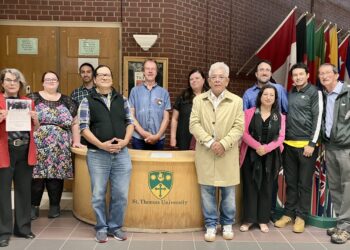
University of New Brunswick alumnus, Lachlan MacKinnon, gave the talk on Monday, Nov. 3 at the Harriet Irving Library on UNB’s Fredericton campus. His talk was hosted by the UNB Department of Historical Studies.

MacKinnon is a Canada Research Chair in Post-Industrial Communities at Cape Breton University. He is an oral historian who researches deindustrialization in Cape Breton and author of Closing Sysco: Industrial Decline in Atlantic Canada’s Steel City (2020). Recently, he also coedited the book Cape Breton in the Long Twentieth Century (2024).
MacKinnon’s recent talk topic was “Cinematic Ruin: My Bloody Valentine and Industrial Crisis in Cape Breton, 1979-1990.”
Filmed in 1981, My Bloody Valentine is a slasher film directed by George Mihalka, a Quebec-based film director originally from Hungary. This film of the horror genres, adheres to the style of filmmaking inspired by Italian filmmakers of the “giallo” style like Dario Argento, and other classics of the horror and slasher genre. Reportedly, this film is director Quentin Tarantino’s favourite in the slasher genre.
The company making the film was called Cinépix, which “did not produce high art” according to MacKinnon, but then shifted towards the horror genre. Acclaimed Canadian director David Cronenberg made two films with Cinépix.
Making the film in Cape Breton, director Mihalka takes the slasher genre and situates it in the deindustrialized setting, with coal miners as some of the protagonists. Miners are introduced within the first three minutes of the film, doing their regular work.
The film, according to MacKinnon, is “working class representation within the horror genre.”
The film was made in Sydney Mines, Nova Scotia, where the Princess Mine had been defunct since 1975. Over the coal mine’s lifespan, 120 men had died there, “the very real tragedies that occur in these spaces,” according to MacKinnon.
Although a young woman is killed first in My Bloody Valentine —following the slasher film rules— regular and older people are killed later on in the film.
Cape Breton coal mines were already rife with horrific deaths. The miner trapped in the colliery at the beginning of the film brings to mind the reality of the horror: many mining tragedies.
According to MacKinnon’s research, just previous to when the film was made, a fire at the No. 12 mine, killed two men in 1973. This accident shut down that Colliery in the early years of the Cape Breton Development Corporation (DEVCO) trying to maintain production. In 1979, twelve men were killed in the No. 26 Colliery in Glace Bay, leaving behind 32 children.
The slasher film echoes the mining disasters of Cape Breton in very strange ways; MacKinnon says “the explosions are narrative background” in the film. In real life, the hundreds of men who really died in the mines were remembered in vigils and memorials.
For the researcher, the film is important because it gives a “view into the community at a moment of transition.”
DEVCO, established after 1966, was created to manage the transition away from coal mining on the island. DEVCO nationalized coal production and became an economic development organization.
The burgeoning film industry in Nova Scotia included tax write-offs for filmmaking, which is probably what attracted the production to Sydney Mines.
The film also swings away from “real life” in interesting ways. For example, worker solidarity is rejected in the film, where the coal miner cannibalizes other miners to survive underground in the mine.
Interestingly, the film also serves to instruct the audience about some of the details of coal mining, such as why the walls of the mines are white with limestone.
When studying the film, tension arises around the making of the film in “a site of collective trauma,” according to MacKinnon. He suspects that the filmmaking company might have misled locals about the film and its aims, leading to a quick approval of the slasher project by naïve mining officials.
For MacKinnon, My Bloody Valentine, is particularly representative of life in the coal communities in Cape Breton, “at the precipice of an economic shift.”
Sophie M. Lavoie is a member of the NB Media Co-op’s editorial board.


![New Brunswicker deported from Egypt following crackdown on March to Gaza [video]](https://nbmediacoop.org/wp-content/uploads/2025/06/JeffHoulahanJun142025-350x250.jpg)
![Amid push for ‘nation-building projects,’ critics warn of ecological devastation [video]](https://nbmediacoop.org/wp-content/uploads/2026/10/MineBabyMineSept242026-2-120x86.jpg)


![NB Update: What comes after the crisis in local journalism? [video]](https://nbmediacoop.org/wp-content/uploads/2025/06/LabourUpdateApr132025-120x86.jpg)
