

Resource companies have obtained exploration rights for land directly bordering the site of the Sisson project, a controversial proposed tungsten and molybdenum mine 60 kilometres northwest of Fredericton.
The area around the Northcliff Resources site has seen a flurry of mineral claims this year, government records show.
Licensed prospectors can acquire exploration rights by staking claims, a process that once involved placing physical stakes on the land but is now done through an online system known as NB e-Claims. Those exploration rights can also be bought and sold.
Makenita Resources and Adelayde Exploration, both publicly-traded companies based in Vancouver, have recently announced acquisitions totalling more than 19,000 acres (roughly 7,700 hectares or 77 square kilometres).
The latest acquisitions follow efforts from Ottawa and the Pentagon to speed up development of the Sisson project.
Makenita announced last week that it had staked out new claims effectively doubling its holdings west of Sisson, for a total of 9,400 contiguous acres. This followed a previous 4,000-acre acquisition announced in November.
Adelayde Exploration Inc. — previously known as Spearmint Resources — announced in October that it had closed a deal to acquire “89 claims consisting of approximately 4,890 contiguous acres prospective for tungsten.”

Combined with earlier acquisitions announced in February, that brings Adelayde’s total holdings to “9,780 acres prospective for tungsten,” north and northwest of the Sisson project site.
Officials from Makenita and Adelayde didn’t respond to interview requests.
In their official communications, the companies have noted higher prices for tungsten driven by geopolitical tensions coupled with surging demand in military, aerospace, and electronics sectors.
Those factors have renewed interest in the long-delayed Northcliff Resources project, resulting in millions of dollars in new investments from the Canadian government and the American military establishment.
Makenita noted those developments in a December 2025 investors presentation, which said the company “is currently formulating work plans for the Sisson West Tungsten Project.”
The companies appear to be jumping on Northcliff’s bandwagon, hoping to find previously unknown tungsten deposits, said Jamie Kneen of MiningWatch Canada, an Ottawa-based watchdog group.
“It’s basically speculative, until a deposit is found and a buyer is found,” he said, adding that a viable deposit would likely be sold to Vancouver-based Northcliff Resources, if that company’s proposed mine goes forward.
READ MORE: Pentagon funding of mine provokes renewed opposition from Wolastoq Elders
READ MORE: No mention of UNDRIP in new minerals strategy framework
READ MORE: Holt says uptick in Sisson mine development expected by spring
Companies including SQM Canada and Great Atlantic Resources have also registered claims near the Sisson project site this year, provincial government records show.
While exploring for minerals, companies aren’t legally required to take steps such as consulting with Indigenous rights holders or obtaining their consent. Nor are they required to notify residents, leaseholders or property owners until they register the mineral claim.
Surface and mineral rights are legally separate in most parts of Canada, meaning that subsurface rights are owned by the state on public and private land.
Kneen renewed warnings about potential environmental harms linked to mining in the area, part of the Nashwaak River watershed, which flows into the Wolastoq River.
Ore quality at the Sisson project site is expected to be low, producing “less than 0.09 per cent marketable metal, and over 99.91 per cent waste in the form of mining residues containing many toxic substances,” according to a 2016 report from MiningWatch Canada.
The low-grade ore explains why the project hasn’t proceeded yet, said Kneen, who called it “a terrible deposit.”
A spokesperson for the Sisson Partnership, which is owned by Northcliff Resources and its parent company, New Zealand-based Todd Minerals, didn’t respond to a request for comment.
The Sisson project received environmental approvals from the provincial government in 2015 and from Ottawa in 2017.
The project would involve the creation of a massive tailings dam that critics say would be among the world’s largest. Opponents of the project fear that the tailings dam will breach, devastating the watershed.
Environment Minister Gilles LePage told reporters last month that none of the 40 conditions attached to the provincial approval are complete, the CBC reported.
The province has repeatedly extended a deadline for the company to begin construction, most recently pushing it back to 2030, with new conditions including updates to various studies.
Critics have said the original design is out of the date and the original environmental impact assessment should be scrapped, but Premier Susan Holt has stated that the government won’t restart the process.
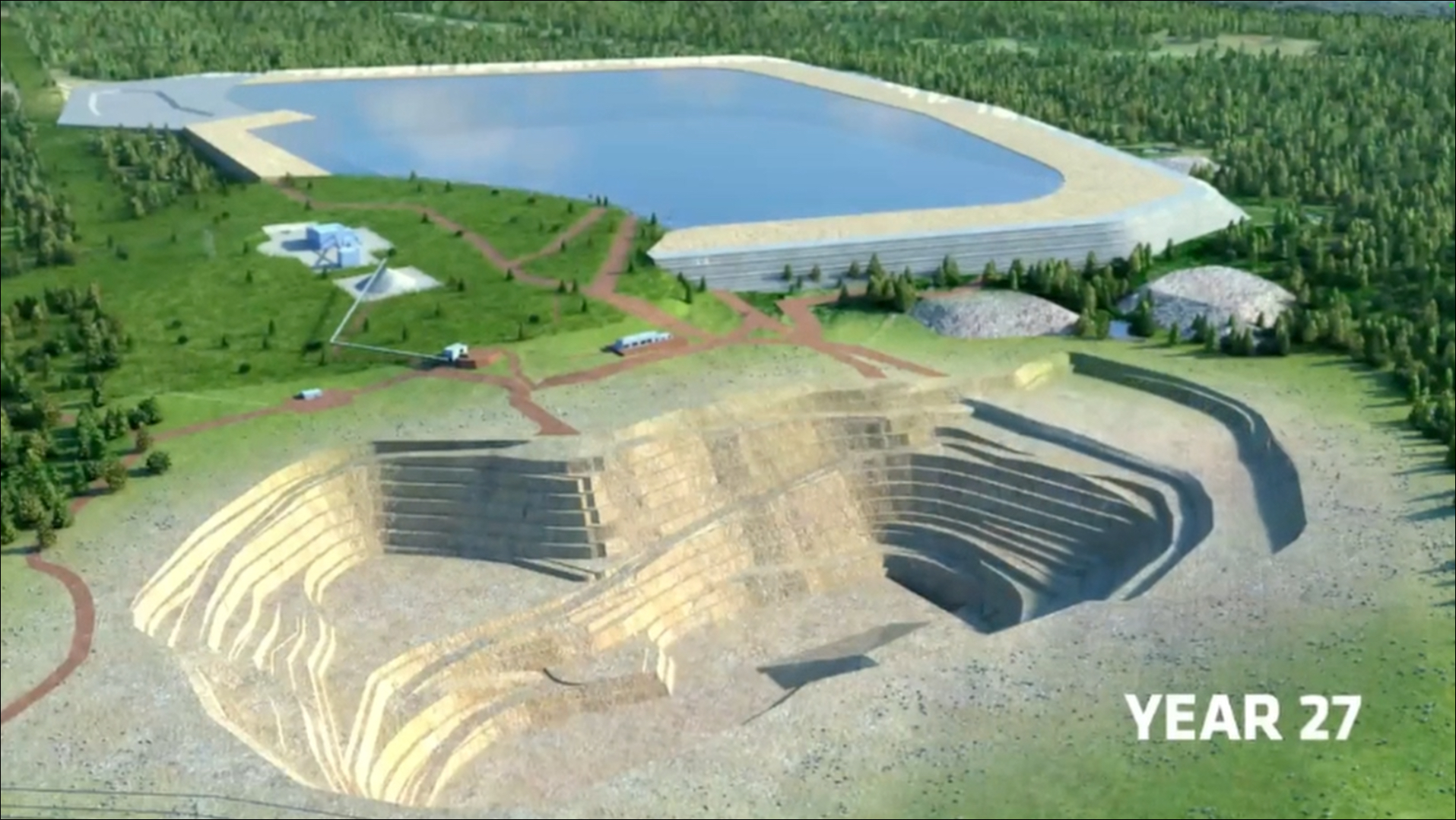
New Brunswick’s Liberal government has touted the mining sector as an engine of economic growth amid the ongoing trade war with the U.S.
In particular, Holt has promoted the presence in New Brunswick of “critical minerals” — including tungsten and molybdenum — identified by the federal government as essential for various applications ranging from weapons to EV batteries.
China has restricted the global supply of minerals such as tungsten in response to U.S. tariffs, causing prices to soar.
In turn, the U.S. Department of Defense — rebranded as the Department of War by President Donald Trump — awarded Northcliff Resources $20.7 million to accelerate the Sisson project earlier this year, while the Government of Canada provided the company with another $8.2 million.
Prime Minister Mark Carney announced last month that the Sisson project would be referred to the federal government’s newly created Major Projects Office, which is mandated to speed up “nation-building projects.”
It’s unclear what that will mean in practice for the Sisson project, but Holt has stated that the province is pushing for a price floor and an offtake agreement to attract investment.
The Premier said last month that Indigenous communities have been in negotiations with Northcliff and Todd Minerals over a potential equity partnership.
In 2017, all six Wolastoqey communities signed revenue-sharing agreements with the province. A statement on the organization’s website says that “the Wolastoqey chiefs insist that all proper processes will be followed and the conditions upon which the mine was established will be maintained.”
In 2021, Wolastoqey Nation launched a case seeking legal confirmation of Aboriginal title over the unceded Wolastoq watershed covering roughly one-half of the province. This week, the New Brunswick Court of Appeal narrowed that claim to exclude land owned by three forestry companies, a decision that Wolastoqey Nation in New Brunswick has said it will seek to challenge in the Supreme Court.
The Wolastoqey Grand Council, which represents a traditional governance structure and has a grassroots constituency, opposes development of the mine. In 2023, a judge issued an injunction barring anyone from interfering with the company’s work at the site.
David Gordon Koch is a journalist with the NB Media Co-op. This reporting has been made possible in part by the Government of Canada via the Local Journalism Initiative.
![Is a Moncton company helping to build jet fighters bombing Gaza? [video]](https://nbmediacoop.org/wp-content/uploads/2024/06/ApexMay192024-350x250.jpg)
![Massive increase in military spending imposed by U.S. with little media pushback [video]](https://nbmediacoop.org/wp-content/uploads/2026/10/AlexCoshSept232026-350x250.jpg)
![Amid push for ‘nation-building projects,’ critics warn of ecological devastation [video]](https://nbmediacoop.org/wp-content/uploads/2026/10/MineBabyMineSept242026-2-350x250.jpg)




![NB Update: What comes after the crisis in local journalism? [video]](https://nbmediacoop.org/wp-content/uploads/2025/06/LabourUpdateApr132025-120x86.jpg)
