A rift has emerged between the Canadian Federation of Students (CFS) and one of its members, the University of New Brunswick Graduate Students Association (UNB GSA), over a campaign to help Palestinian students with acceptance letters from Canadian universities who remain stranded in the Gaza Strip.
The CFS has called on Ottawa to issue study permits to roughly 130 Palestinian grad students, and to use Canada’s diplomatic leverage to evacuate them from the shattered Gaza Strip. Meanwhile, UNB GSA has refused to comment, even though two prospective UNB grad students are among those trapped in Gaza.
At a recent virtual news conference, CFS officials said that student unions have a responsibility to fight for scholars who are facing an Israeli military campaign that human rights organizations have denounced as a genocide.
“We believe in free and accessible high quality education for all,” said Owen Skeen, chair of CFS-Nova Scotia.
“I think it’s absolutely the responsibility of student unions to speak up, to engage in dissent, and to be clear about the rights of students throughout the world,” he said.
The national student organization recently sent a letter to Prime Minister Mark Carney, asking him to urgently address the barriers facing Palestinian students admitted to Canadian universities.
Mary Feltham, national treasurer of CFS National, said that the national organization has a mandate to represent its members across the country.
“If it’s not directly coming from the local, it has been extended through the national and provincial components through their voting in national meetings,” Feltham said.
She added that leaders of the CFS believe “this is something that we ought to be speaking out on as a form of collective solidarity.”
The NB Media Co-op has extensively reported on the story of Baraa, a Palestinian student who was accepted into grad studies at UNB but remains trapped in the besieged territory. (We have agreed to withhold his surname due to concerns about his safety.)
Advocates have now revealed that Baraa isn’t the only prospective UNB student in this situation. He’s one of two Palestinians who were accepted into UNB’s Master of Computer Science program but cannot leave Gaza, according to the non-profit Palestinian Scholars and Students at Risk Network (PSSAR) Network.
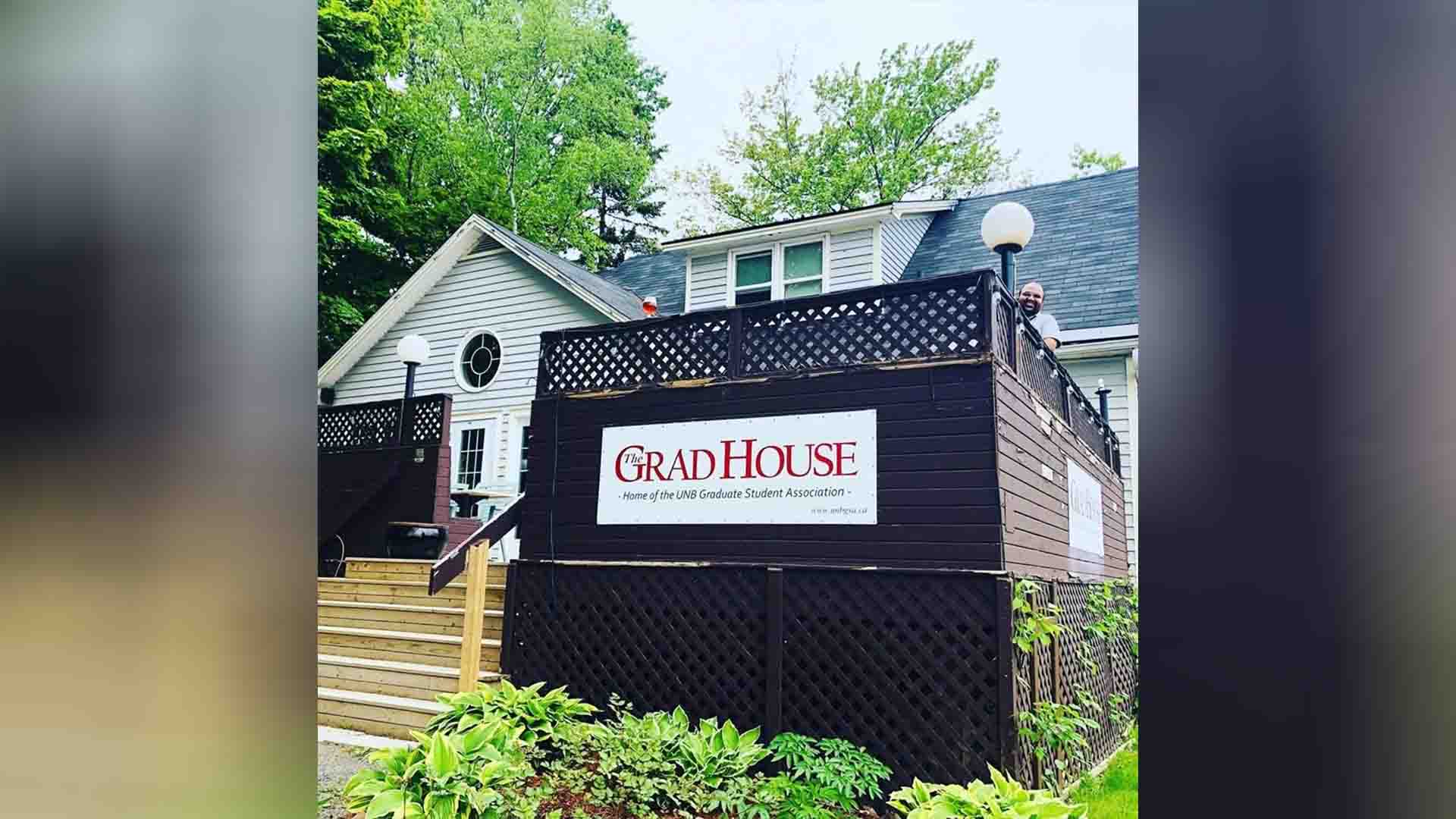
The UNB GSA has said it cannot comment due to unspecified “privacy reasons,” and has suggested that the stranded scholars aren’t, in fact, part of the association.
A member of the GSA executive made the comments after the NB Media Co-op published an article in late July drawing attention to the organization’s silence.
At the time, UNB GSA Vice-President Academic Quazi Mohona issued a brief emailed statement saying that “for privacy reasons, we are unable to comment on any specific individual’s circumstances.”
However, it’s unclear what kind of privacy concerns the student politician had in mind.
The provincial Right to Information and Protection of Privacy Act — which restricts the handling of personal information by public bodies — doesn’t apply to student unions, and Baraa went public with his story in November 2025.
In July, Baraa told the NB Media Co-op he had reached out to the GSA for support. On Tuesday, he said he still hadn’t received a reply.
Mohona also appeared to indicate that the GSA doesn’t represent Baraa or other prospective UNB students who might find themselves in a similar bind.
“[W]e can clarify the general distinction between acceptance and enrollment,” Mohona stated.
“An applicant to a graduate program at UNB may be accepted into a program before becoming enrolled at the University. The individual becomes a student only once enrollment is complete. The Graduate Students Association represents enrolled students; it does not represent applicants or prospective students.”
However, that comment raised more questions than it answered.
For example, Baraa believed that he was technically enrolled, since he has a UNB student number and an active UNB email address. When does a student become enrolled, and therefore a member of the association, according to GSA policies? What if the student is unable to complete that process because of a military occupation?
Members of the GSA executive, including President Shabnam Saderi Oskouei, didn’t respond to multiple follow-up queries by email or phone.
The story raises questions about transparency and accountability at the GSA. Its bylaws indicate that the Vice-President Administration is formally tasked with media relations, but it’s unclear if anyone is currently occupying that role.
A link to the “Executive Committee” section of the GSA’s website produces an error message. The website doesn’t appear to include a list of current executive members, an issue flagged by the NB Media Co-op in July. Phone calls during publicly listed office hours went to voicemail.
The GSA’s social media also appears to be dormant. The most recent post on its Facebook page appears to be from November 2023, and its most recent Instagram post appears to be from October 2020.
The GSA’s policy of silence about the dilemma faced by students in Gaza mirrors that of the university establishment.
The UNB administration has stated that it “is unable to provide comment on student visa applications” as the matter is between the applicant and immigration officials.
Immigration, Refugees and Citizenship Canada (IRCC) has insisted that applicants from the Gaza Strip must submit biometrics (fingerprints and photographs), even though no IRCC facilities exist in the bombed-out enclave. Federal regulations allow for exemptions when “collection is impossible or not feasible.”
Even students who have managed to exit the Gaza Strip have faced long delays and refusals that advocates have characterized as arbitrary. Those who were eventually interviewed by Canadian officials were subjected to aggressive questioning, the PSSAR Network has stated.
IRCC has repeatedly stated that it is “committed to a fair and non-discriminatory application of immigration procedures,” but advocates have said the treatment of Palestinian students from the Gaza Strip reflects a racist double standard.
The NB Media Co-op reached out to IRCC for comment for this story. In response, the federal department provided an emailed statement that largely repeated earlier talking points.
“IRCC continues to work with partners to expedite the processing of applications,” the statement said, in part. (You can read the full statement here.)
The statement didn’t respond directly to a question about whether Ottawa had communicated with countries including Israel and Egypt about coordinating the evacuation of students from the Gaza Strip.
However, it said that “efforts to advocate for the safe exit of applicants are ongoing,” without providing any details.
While his formal education is on hold, Baraa is involved in initiatives that include volunteering at a school in al-Mawasi, the site of an overcrowded displacement camp near Khan Younis.
His old neighbourhood has been completely destroyed by Israeli bombardments, he said via instant message. “There is nothing left, the whole neighbourhood turned to sand.”
Amid the devastation, children at the school recently organized a successful science exhibition, as described by Baraa in an article he wrote for the NB Media Co-op.
“They wanted to create a space where they could present their scientific ideas and creativity, despite the severe shortage of materials and resources available under the current circumstances,” he wrote.
UNICEF reported last year that more than 97 per cent of schools in the Gaza Strip had been damaged or destroyed since October 2023, and that 91.8 per cent of all education facilities would require full reconstruction or major rehabilitation.
Meanwhile, Israeli attacks continue in Gaza, 11 months after the so-called ceasefire came into effect, with children among the casualties.
In recent days, an Israeli strike reportedly hit a vehicle in Gaza City, killing a man and his eight-year-old daughter. East of Gaza City, a tank reportedly fired on a school housing displaced families, killing a three-year-old child.
David Gordon Koch is a staff reporter with the NB Media Co-op. This reporting has been made possible in part by the Government of Canada, via the Local Journalism Initiative.