Sexism and sexual violence are at the centre of new exhibit by Jacqueline Carr, a Fredericton-based mixed-media artist.
In October, the Charlotte Street Arts Centre hosted Carr’s art exhibit called What We Carry.
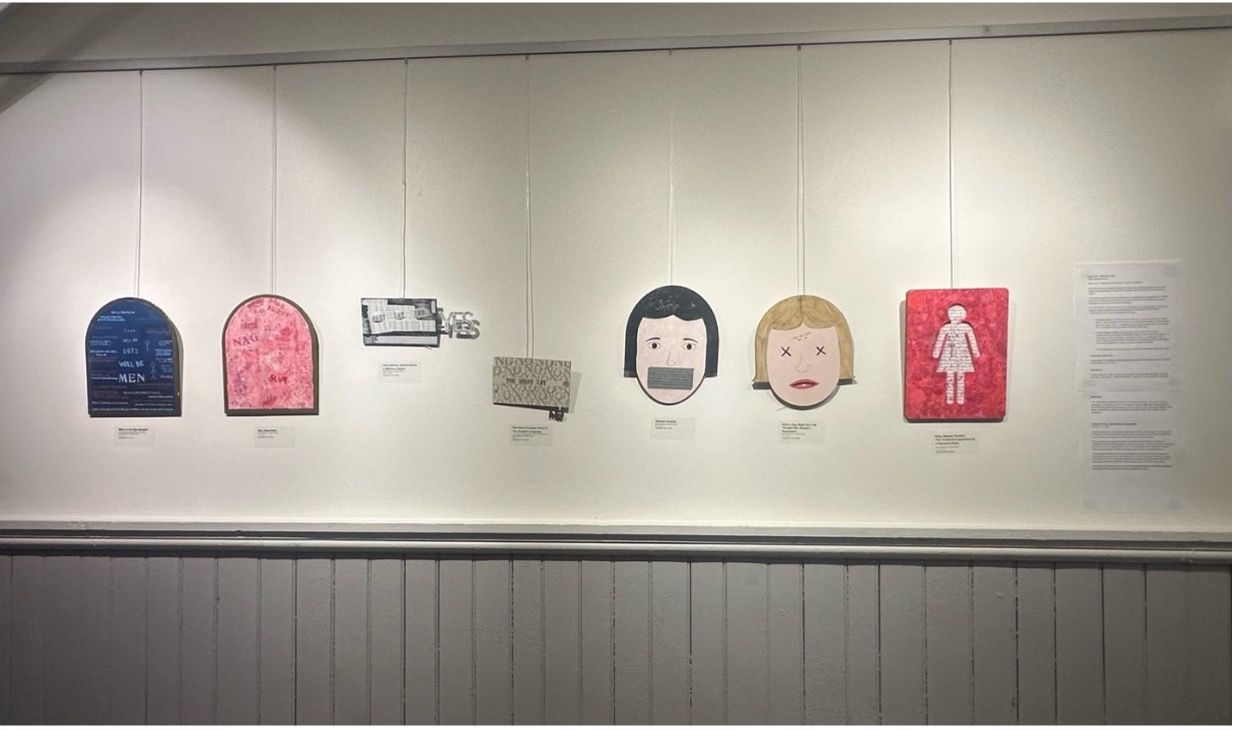
The exhibit shows the weight of the patriarchy through seven pieces of art, each with an important message.
Challenging biases and sharing stories, the exhibit shows the oppressive language and actions that impact women. More information about Carr and her art can be heard in this interview with CHSR FM 97.9.
The first phase of the exhibit is called the “engagement and studies phase.” The project depended on community dialogue. This community dialogue came in the form of questions to be answered with an anonymous ballot. The answers can be seen in the artwork on display.
According to the government of New Brunswick’s Domestic and Intimate Partner Violence (DIPV) Key Concepts and Statistics report, in 2025, women faced more intimate partner violence than men. Usually for both women and men, the perpetrator was someone they knew. But in public, more often than not, was a stranger.
Women who had disabilities were sexually assaulted at double the rate of women: 5.5 per cent vs 2.8 per cent. The same pattern was seen with men. About three in 10 women who endured sexual assault (29 per cent) or physical assault (32 per cent) stated they suffered various mental health struggles, including post-traumatic stress disorder.
One of the pieces at Carr’s expo was titled Blink of the Eye Sexism. The piece showcases words and phrases men have said to women. Some of these phrases included: “My house, my money, my rules,” “Women shouldn’t dress so provocatively,” and “Men have an innate right to women’s attention, affection + bodies.”
Another piece was called She Described. This piece also served the purpose of showing words and phrases women have been called before: “Bossy,” “easy,” and “tease.”
Carr’s art is pushing back on the idea of the male gaze where women are just there to be submissive and pleasing to men.
The most complex word in the English language is a piece of art that says “you didn’t say no” with the word “no” written in different languages around it.
There is an ongoing issue of consent; people understand the word “no” but still do not follow it when it is said. That “no” is not the only way to tell someone you do not want to proceed further with them. Body language, actions, other words and phrases also serve the same purpose.
Internalizing subservience, a mother’s advice has “Just say yes” written over the artwork. The phrase was told to a woman by her mother when she was 15 years old. This phrase came in response to what you should do when a potential abuser says something. For some people, it may be easier to say “yes” than to try and tell him “no.” People may fear the abuser will still do the thing anyway as if the word “no” has no meaning to them.
There were three other pieces of art that were images of women. Volume Control featured the head of a woman with tape over her mouth. This tape in different ways told women they need to be quieter.
Phrases included: “Women should be seen and not heard,” and “I feel bad for the man who marries you.” Art like this shows that despite the words being said we should look past them and not be quieter.
What a Guy Might Do if he Thought she Wouldn’t Remember, also featured the head of a person, eyes crossed out and a pill-like thing in her mouth. On the forehead of this person is written the words “Now you can’t say no.” This piece showcases the fact that some abusers will go extreme lengths just to get their way.
The artwork titled Easy, Breezy, Hurtful: The 10-Second Appraisal of a Woman’s Body showcased arrows pointing at different parts of a person’s body with words. One arrow pointing near the bottom of her leg said: “Reduce thickness here.” This type of comment shows how people think a woman is supposed to look and what she needs to change in order to achieve ideal appearance. This artwork makes you stop and reflect on the fact that people are so much more than their looks.
Of course, not all men should be seen this way but, as statistics show, there are enough out there doing and saying these types of things to women. This exhibit fully encapsulates the experiences some women go through.
There is no set date for phase two of the exhibit which will be called What We Carry Underneath. In this exhibit, Carr will rebuild the lining of various women’s garments that are preloved or vintage. The exhibit will also include the experiences, phrases and words displayed in phase one.
Carr left a note by her exhibit diving into both phases. She says: “Both phases of my project should serve to challenge viewers to consider what they are asking others, specifically women and girls, to carry.”
While experiences like those described can make people scared to speak up, there is always someone willing to help.
Sexual Violence New Brunswick is a non-profit organization that supports survivors of sexual violence. They have a support line open every day from 5 p.m. to 8 a.m. There is a wide variety of services they offer which include group support and counselling for people individual of any gender ages 16 and up.
They also conduct work on the campuses of University of New Brunswick, St. Thomas University and New Brunswick Community College, providing awareness, support, advocacy and prevention. Counselling services are also available on these campuses.
The path towards healing doesn’t have to happen in silence. Survivors are not alone; whether it’s a friend, family member or professional worker, you will find someone ready to listen.
Emma Benjamin is a UNB student studying English and is originally from Nova Scotia. She is completing an Arts 3000 Internship with the NB Media Co-op.