

Two dozen people rallied against shale gas in New Brunswick outside a natural gas conference in Moncton on a frigid November 15th. They waved colourful signs and moved their bodies to the beat of a drum.
The rally was a forewarning that rural New Brunswick may soon again become the site of conflict as residents determined to protect the health and integrity of their rural environment oppose the will and power of the provincial government.
“We are extremely disappointed and alarmed about recent statements from the incoming New Brunswick Premier, Mr. Blaine Higgs, that his government intends to lift the moratorium on fracking for shale gas in Sikniktuk,” said Kenneth Francis, spokesperson for Kopit Lodge at Elsipogtog First Nation. Kopit Lodge is tasked with working on resource development issues for the First Nation.
Sikniktuk is the traditional lands of the Mi’kmaq people. “It has never been ceded or surrendered to the Crown,” says Francis.
Blaine Higgs’ Progressive Conservative cabinet was sworn in on Nov. 9 after Brian Gallant’s Liberal government lost a confidence motion to govern on Nov. 2. Higgs has said that his government will move to lift the moratorium in places that support shale gas development soon after the new legislature begins on Nov. 20.
One of those places that Higgs sees open for shale gas is the rural Sussex region, part of the unceded Sikniktuk territory.
While the Conservative MLA for Sussex-Fundy-St. Martins, Bruce Northrup, supports lifting the moratorium by Christmas, a number of community groups across the province are opposed to fracking for shale gas. The New Brunswick Anti-Shale Gas Alliance wants the government to support the development of green energy sources instead.
Corridor Resources stands to gain the most from the lifting of the moratorium. Corridor operates the McCully gas field in Penobsquis, a farming community next to Sussex.
Penobsquis is not only home to farms; its landscape is dotted with closed potash mines, gas well pads, gas wells, natural gas compressor stations, a drill rig site, a grouting station, an oil well, pipelines and gravel pits.
Penobsquis made headlines in recent years after residents lost their water. They link the loss of their water to seismic testing done by Corridor Resources in PotashCorp’s potash mine.
Jonathan Richardson, a former Penobsquis resident who represents the NDP at the federal level for Atlantic Canada, wrote on Facebook: “I am 100% against fracking in my province – period! I remember when I lived near Corridor in #Penobsquis and our water became contaminated. Months I had to take sponge baths using boiled water and carry down water for the houses. Because of fracking, my family lost our horses and we had to move away from the farm to Ontario.”
Corridor has drilled 39 wells in its McCully Field in Penobsquis to obtain natural gas for markets in the Maritimes and northeast US. Corridor’s McCully F-58 well in Elgin was fracked in 2008 and could be re-fracked for gas production. Their Frederick Brook shale gas prospect is one of “two high impact – high reward exploration prospects,” according to the company’s website.
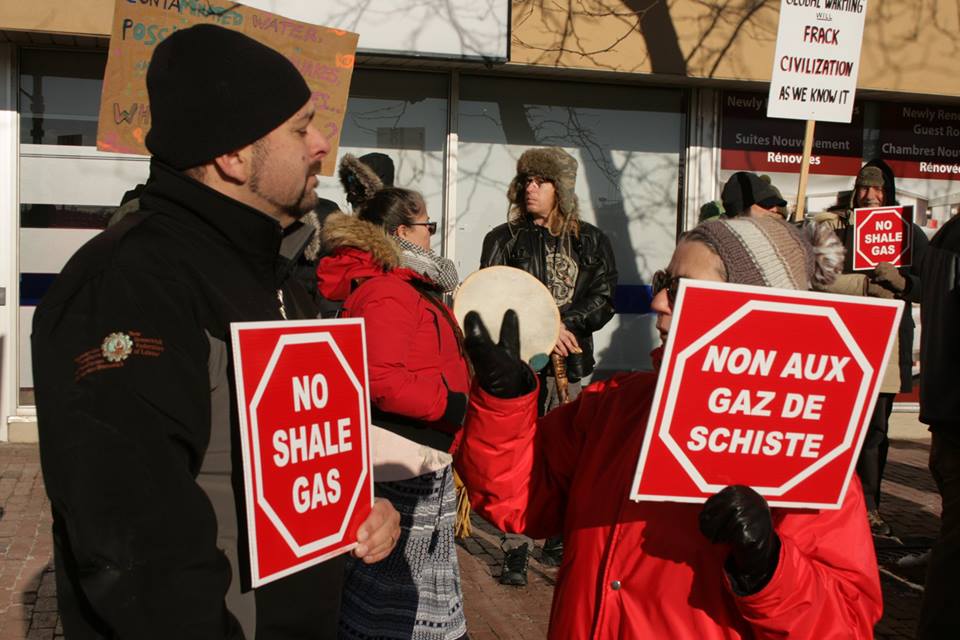
Patrick Colford, president of the New Brunswick Federation of Labour, joined the rally outside the industry conference in a demonstration of solidarity between labour and groups working to protect the rural environment. “We need to stand shoulder to shoulder with our brothers, sisters and comrades to send a clear message to the new Progressive Conservative government that fracking has no place in New Brunswick.”
“I am yet to find out what economic benefit it would bring to our province. Shale gas is basically worthless. It is another example of our province giving away our collective wealth to multinational corporations,” says Colford.
Ray Ritcey, CEO of the Maritime Energy Association, was at the Moncton conference while the protest against shale gas was outside. He told CBC that he was in favour of lifting the fracking moratorium: “We’re really trying to find short, mid-term solutions to a gas supply gap that exists today and is only going to increase by Dec. 31 of this year.” The Sable Island natural gas deposit has been depleted and offshore drilling off the island is expected to conclude at the end of the year.
Shale gas opponents remain committed to keeping the province frack-free.
“Initially there was regret that we have to fight against fracking again, but as all the familiar faces showed up. It felt amazing. It was heartwarming to see that the solidarity between anglophones, francophones, and Indigenous people is alive and well,” said Pamela Ross, one of the organizers of the rally and a member of the Moncton chapter of the Council of Canadians.
Francis agrees with Ross: “In 2013, the entire community of Elsipogtog First Nation stood shoulder-to-shoulder with francophone and anglophone neighbours and allies to successfully defend this area from fracking.”
Francis and Elsipogtog Chief Arren Sock are the plaintiffs on a 2016 Statement of Claim that seeks Aboriginal title to Sikniktuk.
“Kopit Lodge will take whatever steps are necessary to protect our water from practices like fracking,”says Francis.
This article was produced with the support of RAVEN – Rural Action and Voices for the Environment.
Tracy Glynn is a doctoral researcher working with RAVEN and an editorial board member of the NB Media Co-op.


![Student accepted into UNB grad program stranded in Gaza awaiting Canadian study permit [video]](https://nbmediacoop.org/wp-content/uploads/2025/11/BiometricsNov72025-5-120x86.jpg)
