
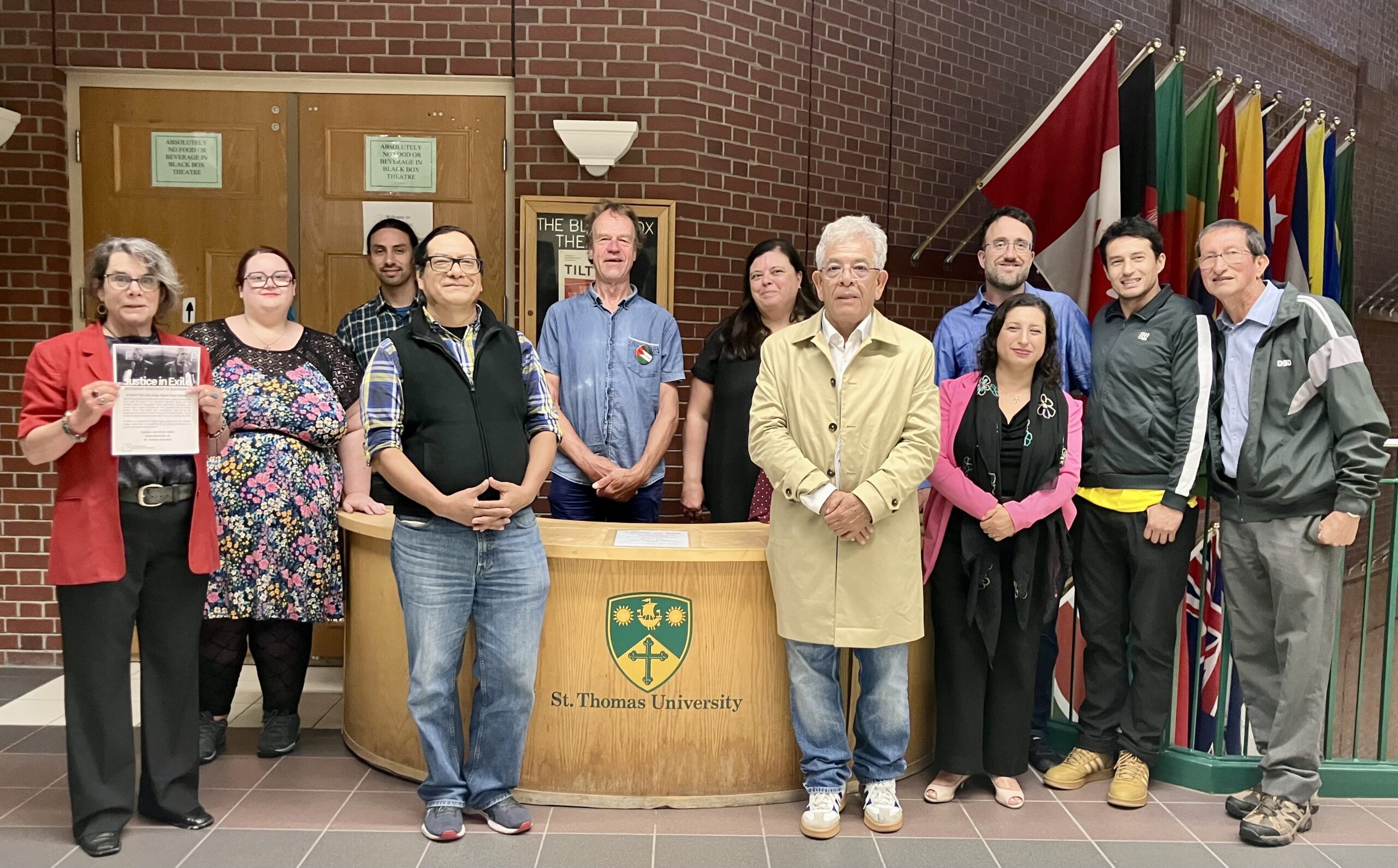
Guatemalan Judge Miguel Ángel Gálvez visited Fredericton on June 23 to discuss the insidious nature of corruption and use of lawfare in his country.
Josephine Savarese from the Criminology Department at St. Thomas University in Fredericton opened the event quoting lines from Rafeef Ziadah’s poem, “We teach life, sir,” about understanding Palestine beyond media soundbites. Savarese encouraged those present to resist the skepticism that meets the rote repetition of land acknowledgements can provoke.
Forced into exile in 2022 from Guatemala, Judge Gálvez received a Human Rights Award from the German Judges Association. He has lived in Costa Rica ever since.
Gálvez admitted at the start of his talk that, although he had studied corruption, “I hadn’t understood the levels of corruption present in Guatemala and Latin America … I had to leave … they wanted to kill me.”
Gálvez reminded those present about the fraught history of his home country and its decades of U.S. intervention. For Gálvez, this context caused the establishment of strong military forces in the country, an institution that itself was full of discontents and eventually developed into Guatemala’s “36 years of armed conflict.”
The 1996 Peace Accords included a human rights agreement to “investigate illegal entities and security apparatus that work clandestinely.” A U.N. Commission for Historical Clarification was created to investigate the violations to human rights, the majority committed by the military. Originally conceived as a two-year task, it took ten years, from 1994-2004.
Gálvez clarified that the final report found that “the State of Guatemala did not cooperate to eradicate these specific bodies.” This historic report Guatemala, nunca más (Guatemala: Never Again!) —in four volumes— reviewed the conflict’s origins. The human rights violations continued after the Commission, including the death of a priest in 1998, Juan José Gerardi Conedera, one of the authors of the report.
Gálvez said that, eventually, in Guatemala, the entire military and judicial system, all of the institutions, were “coopted … and don’t work independently.”
After the armed conflict, there also begins to be a wave of criminalization of Indigenous peoples, especially around the issue of resource extraction in Guatemala. “Canada is deeply involved in that,” Gálvez reminded the people in the room.
The criminalization of Indigenous peoples led to calls for the creation of the International Commission against Impunity (CICIG) in 2008. The U.N.-backed Commission was short-lived. In 2015, Guatemalan President Jimmy Morales, a supporter of Donald Trump, orchestrated the closure of the Commission after the anti-graft body and local prosecutors began investigating him, his brother, and his son for illicit campaign financing and corruption.
The second wave of criminalization took place after 2015, following a reconfiguration of the judicial system. Gálvez said: “we don’t give the governments we elect a blank cheque” yet “they use the judicial system to criminalize people who do not align with the specific system they want in place.”
This technique is used in many countries, “a phenomenon known as lawfare.” Lawfare, a term close to warfare, is the use of legal systems and institutions in a country to disturb its effective operation. In 2019, a wave of journalist arrests was linked to the use of lawfare.
In the 2023 elections, the left-leaning Movimiento Semilla party (‘Seed Movement’) won the election, with Bernardo Arévalo as the leader. Arévalo is the son of Guatemala’s first democratically-elected president, Juan José Arevalo, who had started a series of democracy and land reforms in 1944. According to Gálvez, all the other parties in the 2023 election had been funded by corrupt entities in the traditional political and economic sectors. There was immense pressure to keep Bernardo Arévalo out of government.
Despite the pressure, Bernardo Arévalo eventually came into government with eight different accusations against him and three pre-trial dates already made, according to Gálvez. These accusations were all part of the attempts to keep him out of power.
For Gálvez, who has been waiting to return to Guatemala, the outcome of this power struggle is massive. In 2027, there will be elections and, because of the context, electoral candidates from the traditional political and economic sectors, supported by the U.S., will be in the running, including the daughter of dictator Efraín Ríos Montt, the person whose trial Gálvez headed.
Gálvez, in a clear understatement, called the political context in Guatemala “quite complicated.” He encouraged the attendees to keep abreast of the goings on. Having seen this evolution in multiple countries, he warned of this type of situation happening in other places, with the rise of the far right.
Members of the public discussed the rise of the far right in various countries, such as Colombia, Honduras, and Peru, where the expatriate vote has been decisive in swaying elections, according to Gálvez.
Jeremias Tecú, from the Maritimes-Guatemala Breaking the Silence Network, remarked that, after welcoming dozens of Indigenous activists, hosting Judge Gálvez in Fredericton was very impactful and telling of the situation in his country.
Gálvez is someone who was a high-ranking official and protected by armed guards for decades, but still had to flee in fear for his life. Tecú is himself an exile from the armed conflict in Guatemala and wrote a novel about his exile. Tecú thanked Gálvez for sharing his story and said “there is the hope that we’re sharing our story.”
Part of a Maritimes speaking tour organized by the Maritimes-Guatemala Breaking the Silence Network, Gálvez’s presence in Fredericton was also supported by the St. Thomas University’s Department of Political Science.
Sophie M. Lavoie is a member of the NB Media Co-op’s editorial board and a member of the Maritimes-Guatemala Breaking the Silence Network.




![Photo exhibit shows dangers faced by journalists, daily struggle to survive in Gaza Strip [video]](https://nbmediacoop.org/wp-content/uploads/2026/10/RizekExhibitOct222026-5-120x86.jpg)
